
How does Tracsis integrate real-time rail, crew, and asset data to keep networks moving?
Tracsis runs mission-critical software for rail, traffic, and transit, shifting from project fees to recurring SaaS revenue. In FY2025 it reported growing recurring revenues and improved gross margins, signaling scalable platform economics and higher customer retention.
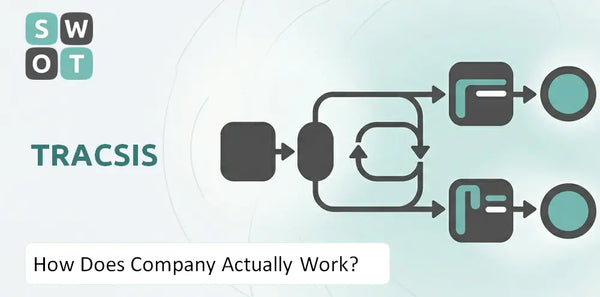
Tracsis products tie telemetry, scheduling, and analytics into one operational layer, reducing delays and cost per move-vital for large operators. See Tracsis SWOT Analysis.
What Does Tracsis Actually Sell?
Tracsis sells an integrated ecosystem of software, hardware, and data analytics that removes operational chaos in transport, combining rail operations control, remote condition monitoring, ticketing, and multimodal traffic analytics to turn telemetry into decisions that cut delays and boost safety.
 Core Offerings: Rail technology and multimodal analytics
Tracsis provides on-day operations platforms for resource planning, crew rostering, and real-time incident management, remote condition monitoring (RCM) hardware that flags failures before they occur, and consumer-facing retail systems for smart ticketing and automated delay refunds.
Who it serves: Operators, authorities, and event managers
Primary customers are train and bus operators, infrastructure managers, city transport authorities, and large event organisers who need accurate passenger flows, timetable resilience, and crowd-management insight across rail, bus, tram, and road networks.
Value delivered: Operational certainty and measurable savings
Customers gain faster recovery from disruption, reduced delay minutes, and lower asset downtime; Tracsis clients report punctuality improvements and cost savings up to mid-single-digit percentages from predictive maintenance and optimized rostering, plus revenue protection via automated ticket retail systems.
Why customers choose it: Integrated, data-rich, and sector-specific
Tracsis combines AI computer-vision traffic data, high-fidelity telemetry, and sector-specific workflows so operators get a single source of truth; integration with legacy signalling and ticketing systems and proven rail analytics track records make replacement costly for clients.
Key 2025 facts: Tracsis' rail technology suites include RCM hardware that reduces unexpected failures by up to 20% in deployed pilots, the ticketing and retail platform supports automated delay refunds for millions of journeys annually, and its data arm supplies multimodal traffic feeds used by city authorities to model peak event flows with sub-5% sampling error; see the History of Tracsis Company Explained for background.
Tracsis SWOT Analysis
- Complete SWOT Breakdown
- Fully Customizable
- Editable in Excel & Word
- Professional Formatting
- Investor-Ready Format

How Does Tracsis Run Day to Day?
Tracsis runs day to day as a hybrid of high-touch enterprise sales and agile software delivery, managing multi-year frameworks with rail operators while operating cloud analytics and rugged edge hardware. The focus is on extreme reliability for live dispatch and safety-critical planning.

Operating model: hybrid enterprise sales plus agile delivery
Tracsis combines multi-year contracts with blue-chip clients and iterative software development. Day-to-day teams coordinate account management, project delivery, and 24/7 platform support across the UK, North America, and Europe.
Service delivery: cloud platforms and edge devices
Customers access Tracsis solutions via cloud-hosted analytics and SaaS modules, complemented by field-installed sensors and dataloggers on trains and track. Live dispatch and passenger-data services run with redundancy and strict SLAs.
Development and sourcing: hardware plus modular software
Engineering builds ruggedized edge hardware and maintains firmware while product teams migrate legacy tools to a modular, SaaS-native architecture. Procurement sources specialized sensors and telecom-grade dataloggers from certified suppliers.
Sales and distribution: direct enterprise channels
Sales operate via account teams, long-term frameworks, and strategic partnerships with Network Rail and TOCs; deployment teams coordinate on-site installs and remote rollouts. Renewals and upsells follow performance and uptime metrics.
Key assets and partnerships: cloud, edge, clients
Core assets are cloud analytics platforms, proprietary algorithms for rail analytics, rugged edge devices, and integrated partner relationships with operators and suppliers. Unified global leadership streamlines cross-region delivery.
What makes it work: reliability and modularity
Operational emphasis on 99.9% availability for live systems, rapid modular updates, and field-proven hardware ensures minimal downtime and fast feature deployment across client fleets.

Daily operations: coordinated delivery for live rail systems
Tracsis runs continuous monitoring, scheduled firmware and software releases, and hands-on account management to keep safety-critical dispatch and passenger-data platforms live and accurate. Teams focus on reliability, rapid SaaS rollouts, and aligning updates with multi-year client frameworks; see Who Tracsis Company Serves for client context: Who Tracsis Company Serves
- Hybrid operating model: enterprise sales plus agile product teams
- Delivery: cloud SaaS modules plus on-train/track sensors and dataloggers
- Main support: long-term frameworks with Network Rail and TOCs and unified global leadership
- Efficiency driver: modular SaaS migration and strict uptime SLAs
Tracsis PESTLE Analysis
- Covers All 6 PESTLE Categories
- No Research Needed – Save Hours of Work
- Built by Experts, Trusted by Consultants
- Instant Download, Ready to Use
- 100% Editable, Fully Customizable

How Does Money Come In at Tracsis?
Money flows into Tracsis through recurring software licenses, project-based systems work, and growing consumer transactional products; the firm focuses on shifting revenue mix toward annual recurring revenue to reduce seasonality and funding swings.
Recurring software license revenue is the core
Tracsis generated 23.2 million GBP in recurring software license revenue in FY25, up 6% year over year; this high-margin ARR underpins the business and stabilizes cash flow for Tracsis solutions and rail analytics offerings.
Project and transactional systems work
Large-scale deployments and hardware installs-such as Train Dispatch systems in North America-drive lump-sum revenue and professional services income, supporting Tracsis technology integration and transport modelling services.
Consumer-facing transactional revenue
Consumer PAYG smart ticketing and delay-repay systems generated 4.1 million GBP in FY25 (+17%); this growing stream broadens monetization via transaction fees and passenger data products.
Pricing and monetization model
Tracsis mixes subscription ARR, one-off project fees, usage-based transaction charges and professional services; enterprise licences for workforce management and analytics are sold alongside project implementation contracts.
How Money Comes In at Tracsis
In FY25 total group revenue was 81.9 million GBP; the clearest path to steadier revenue is growing ARR (recurring software licences) while keeping project wins and PAYG ticketing growth complementary.
- Recurring software licences: 23.2 million GBP in FY25 - the primary revenue stream
- Project-based systems and hardware deployments: large, lumpy contracts (e.g., Train Dispatch in North America)
- Consumer transactional fees: PAYG ticketing and delay-repay systems - 4.1 million GBP in FY25 (+17%)
- Strongest driver: shift toward ARR to smooth seasonality and diversify away from event-driven and government funding cycles
For market positioning and competitor context see Who Tracsis Company Competes With
Tracsis SOAR Analysis
- Complete SOAR Analysis
- Effortlessly Communicate Your Business Strategy
- Investor-Ready Format
- 100% Editable and Customizable
- Clear and Structured Layout

What Makes Tracsis's Model Strong or Fragile?
The Tracsis model is strong because of extremely sticky operational software and a debt-free balance sheet with £23.4 million cash at July 2025, enabling bolt-on M&A; it is fragile due to heavy dependence on UK government funding cycles and episodic large North American project revenues, which drive notable year-to-year volatility.
Structural Advantage: Captive Revenue from Sticky Software
Once rail operators adopt Tracsis workforce planning, dispatch, or ticketing modules, switching costs and integration complexity create recurring, captive revenue and high lifetime customer value-this underpins how Tracsis works commercially.
Key Assets: Debt-Free Balance Sheet and Tech Stack
Tracsis owns proprietary rail analytics, real-time passenger data platforms, and predictive maintenance tools; with £23.4 million cash and no debt as of July 2025, it can fund modular SaaS shifts and selective US/Europe expansion.
Dependencies: Government Funding and Large Project Lumpy Revenue
Revenue is concentrated in UK public-sector cycles (Network Rail CP7) and intermittent large North American deployments; CP7 funding constraints caused a 42% fall in UK Remote Condition Monitoring hardware revenue, showing sensitivity to external budgets.
Durability in 2025-2026: Conditional on SaaS Transition and Diversification
The model can be durable if Tracsis converts on-prem modules to modular SaaS and scales recurring revenue in US/Europe; otherwise reliance on UK public spend and project lumpy income keeps margins and growth volatile.
Why the Model Holds or Breaks
Tracsis succeeds via sticky operational software and a clean balance sheet, but UK funding cycles and one-off large projects create predictable points of fragility; success hinges on SaaS migration and international revenue steadiness.
- Sticky operational modules create high switching costs and recurring revenue
- Proprietary rail analytics and £23.4 million cash support expansion and product development
- High dependence on UK public funding (Network Rail CP7) and lumpy North American deployments
- Model looks cautiously resilient if SaaS transition and US/Europe diversification succeed; otherwise exposed to funding volatility
See further context and corporate stance in this company note: What Tracsis Company Stands For
Tracsis VRIO Analysis
- Covers VRIO Analysis in Details
- Structured for Consultants, Students, and Founders
- 100% Editable in Microsoft Word & Excel
- Instant Digital Download – Use Immediately
- Compatible with Mac & PC – Fully Unlocked

Related Blogs
Frequently Asked Questions
Tracsis sells an integrated mix of software, hardware, and data analytics for transport operations. Its offerings include rail operations platforms, remote condition monitoring hardware, smart ticketing, automated delay refunds, and multimodal traffic analytics that help operators reduce delays, improve safety, and turn live data into decisions.
Disclaimer
All information, articles, and product details provided on this website are for general informational and educational purposes only. We do not claim any ownership over, nor do we intend to infringe upon, any trademarks, copyrights, logos, brand names, or other intellectual property mentioned or depicted on this site. Such intellectual property remains the property of its respective owners, and any references here are made solely for identification or informational purposes, without implying any affiliation, endorsement, or partnership.
We make no representations or warranties, express or implied, regarding the accuracy, completeness, or suitability of any content or products presented. Nothing on this website should be construed as legal, tax, investment, financial, medical, or other professional advice. In addition, no part of this site - including articles or product references - constitutes a solicitation, recommendation, endorsement, advertisement, or offer to buy or sell any securities, franchises, or other financial instruments, particularly in jurisdictions where such activity would be unlawful.
All content is of a general nature and may not address the specific circumstances of any individual or entity. It is not a substitute for professional advice or services. Any actions you take based on the information provided here are strictly at your own risk. You accept full responsibility for any decisions or outcomes arising from your use of this website and agree to release us from any liability in connection with your use of, or reliance upon, the content or products found herein.