
How does Southwest Gas Holdings, Inc. move gas from suppliers to homes and businesses while earning regulated returns?
Southwest Gas Holdings, Inc. delivers and distributes natural gas under state regulation, earning returns via approved rate cases. In 2025 it reported steady utility margin growth and constructive regulatory outcomes that support predictable cash flow and capex recovery.
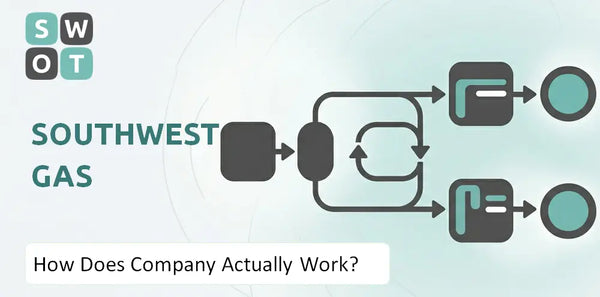
Rates set by regulators drive revenue stability; customer volumes and infrastructure spend drive authorized returns. See operational detail in Southwest Gas SWOT Analysis.
What Does Southwest Gas Actually Sell?
Southwest Gas Holdings, Inc. sells access to natural gas delivery infrastructure: purchasing, transporting, storing, and distributing gas so customers receive safe, reliable fuel for heating, hot water, cooking, and large commercial loads.
 Main Offerings
Southwest Gas Company operates pipelines, an LNG storage facility, metering, and distribution networks that move gas from suppliers to end users. Operations include procurement, system balancing, maintenance, emergency response, and billing systems that underpin service delivery.
Who It Serves
Residential customers (single-family and multi-family), commercial businesses, and industrial clients across Arizona, Nevada, and California make up the customer base of more than 2 million accounts. Municipal and wholesale partners also rely on Southwest Gas operations for bulk deliveries and system access.
Value Delivered
Customers get predictable, regulated access to pipeline-quality gas, backed by physical assets-pipes, meters, compressors, and LNG storage-that reduce outage risk and support seasonal demand peaks. The Great Basin Gas Transmission pipeline and its LNG facility increase supply resilience and system reliability.
Why Customers Choose It
Customers pick Southwest Gas services for consistent delivery under regulated tariffs, widespread service in the Southwest, coordinated outage response, and integrated meter-to-bill platforms. Its mix of long-haul pipeline capacity and local distribution makes switching costly for large users and convenient for residential customers.
For context on strategic direction and numbers tied to operations and infrastructure investments-including 2025 regulatory outcomes and capital plan figures-see Where Southwest Gas Company Is Going
Southwest Gas SWOT Analysis
- Complete SWOT Breakdown
- Fully Customizable
- Editable in Excel & Word
- Professional Formatting
- Investor-Ready Format

How Does Southwest Gas Run Day to Day?
Southwest Gas Holdings, Inc. runs daily as a regulated natural gas distributor, focusing on pipe integrity, meter operations, and regulatory filings to recover costs while serving growing customer demand.

Regulated operating model and asset focus
Southwest Gas Company operates as a pure-play regulated utility after the 2025 deconsolidation of Centuri, managing networks of distribution mains and service lines under state commission oversight.
Service delivery to residential and commercial customers
Customers access Southwest Gas services via meter installs and account setup; the company added approximately 37,000 first-time meter sets in 2025 to support new connections and growth.
Infrastructure investment and pipe programs
Daily crews perform inspections, maintenance, and targeted pipe replacement as part of system integrity programs supported by planned capital expenditures of about $880,000,000 in 2025.
Customer interface and billing
Operational workflows include meter reading, billing cycles, outage response, and account management through online portals and customer service channels; billing and rate recovery are governed by filed rate cases.
Key systems, partners, and regulatory links
Critical assets include distribution mains, service lines, meters, SCADA and GIS systems; regulatory partnerships with commissions such as the Arizona Corporation Commission shape capital recovery and rates.
Practical efficiency drivers
Routine inspections, prioritized pipe replacement, and predictable GRC cycles drive operational reliability and steady returns in a regulated model; removing third-party construction volatility after 2025 improved cash-flow predictability.

Daily operational summary for Southwest Gas operations
Southwest Gas Company runs day-to-day by balancing field maintenance, meter operations, and regulatory filings to fund $880,000,000 of 2025 capital works and absorb 37,000 new meter connections while operating as a regulated utility.
- Core operating model: Regulated natural gas distribution with emphasis on asset management and rate recovery via General Rate Cases
- Service delivery: New meter sets, meter reading, billing cycles, outage response, and online account management
- Main channel/system: Distribution mains, service lines, meters, SCADA/GIS, and state utility commissions
- Efficiency driver: Predictable capital programs and regulatory recovery after Centuri deconsolidation
Related operational detail: How Southwest Gas Company Sells
Southwest Gas PESTLE Analysis
- Covers All 6 PESTLE Categories
- No Research Needed – Save Hours of Work
- Built by Experts, Trusted by Consultants
- Instant Download, Ready to Use
- 100% Editable, Fully Customizable

How Does Money Come In at Southwest Gas?
Money enters Southwest Gas Holdings, Inc. mainly through regulated utility revenues: customers pay for delivered natural gas and for the utility's invested capital, with regulators allowing recovery of costs plus an authorized return on equity. The company earns on its rate base rather than the commodity margin, supplemented by service and nonregulated activities.
Main regulated revenue from gas delivery
Southwest Gas Company's primary revenue stream is regulated delivery charges tied to its rate base; regulators permit recovery of operating costs and a return, so earnings come from infrastructure investment rather than gas commodity markup. For the 12 months ended December 31, 2025, the utility delivered an adjusted utility ROE of 8.3 percent, which directly affects earnings.
Secondary service and nonregulated revenues
Southwest Gas services include customer charges, connection fees, commercial gas service setup, and limited nonregulated activities; these provide supplemental margin and improve cash flow timing. Service-area growth and add-on programs (efficiency rebates, inspection fees) contribute incremental revenue.
Rate-of-return pricing and regulatory recovery
Pricing is set largely by regulators via rate cases: the company recovers prudently incurred operating and capital costs plus an authorized Return on Equity (ROE), producing predictable, tariff-based cash flows. A regulatory approval in March 2025 yielded an approximately 80.2 million dollar annual revenue increase in Arizona.
What most drives revenue
The strongest driver is rate base growth and approved rate adjustments: capital investment in pipelines, meters, and infrastructure expands the rate base and supports higher allowed returns. Customer count, weather-driven volume, and timely regulatory outcomes also materially affect revenue.
How money comes in at Southwest Gas
Southwest Gas turns demand into revenue by billing regulated delivery rates that recover costs and pay an allowed ROE; regulatory approvals and rate-base growth are the levers that increase earnings. In 2025, adjusted net income from continuing operations reached 263.7 million dollars, and 2026 adjusted EPS is projected at 4.17 to 4.32 dollars.
- Main revenue: regulated delivery charges tied to rate base recovery
- Secondary monetization: service fees, customer charges, and limited nonregulated activities
- Pricing model: regulator-set tariffs that recover costs plus authorized ROE
- Top revenue driver: rate base growth and successful regulatory rate case outcomes
See further context on competitors and market positioning in this article Who Southwest Gas Company Competes With.
Southwest Gas SOAR Analysis
- Complete SOAR Analysis
- Effortlessly Communicate Your Business Strategy
- Investor-Ready Format
- 100% Editable and Customizable
- Clear and Structured Layout

What Makes Southwest Gas's Model Strong or Fragile?
Southwest Gas Holdings, Inc.'s model is strong because its near-monopoly service territories and an upgraded S&P rating of BBB+ create predictable, regulated cash flows and lower borrowing costs; it is fragile because regulatory decisions and long-term electrification trends could stall rate base growth.
Regulated monopoly and credit profile support the model
Southwest Gas operations benefit from limited competition across its service area, producing stable volumes and allowed returns set by regulators. The BBB+ S&P upgrade in 2025 lowers interest expense and supports capital access for a $1.2-1.6 billion Great Basin Expansion Project opportunity.
Key assets and execution strengths
Southwest Gas Company maintains an extensive pipeline network, disciplined capital plan and operational focus on safety and maintenance, enabling reliable service delivery and steady rate base growth. A lean, pure-play structure and a 5-year capital plan through 2030 support steady dividends, increased to $2.58 annually starting 2026.
Dependencies, constraints and regulatory risk
Southwest Gas services depend on regulator-approved rate cases and allowed returns; denial or lower ROE (return on equity) compresses cash flow. Demand is exposed to electrification trends and efficiency programs, which could reduce residential heating volumes over the next decade.
Durability assessment for 2025/2026
In 2025/2026 the model looks durable: predictable regulated revenues, improved credit and an active capital program support rate base growth. Still, long-term exposure to electrification and regulatory outcomes leaves downside risk if demand or allowed returns drop materially.
Why the model holds - and what could break it
Southwest Gas Company works because regulated monopolies create predictable cash flow and the BBB+ rating reduces debt costs; it can break if regulators restrict rates or electrification sharply cuts gas volumes.
- Near-monopoly regulated service area is the main structural strength
- Extensive pipeline network, disciplined 5-year capital plan, and improved credit are the top capabilities
- Dependence on regulator-approved rate increases and long-term electrification trends are key constraints
- The model looks resilient in 2025/2026 but exposed to policy and demand shifts
See the History of Southwest Gas Company Explained for context on regulatory and expansion milestones that shape Southwest Gas operations, billing, service area planning, and capital choices.
Southwest Gas VRIO Analysis
- Covers VRIO Analysis in Details
- Structured for Consultants, Students, and Founders
- 100% Editable in Microsoft Word & Excel
- Instant Digital Download – Use Immediately
- Compatible with Mac & PC – Fully Unlocked

Related Blogs
- What Does Southwest Gas Company Stand For?
- How Did Southwest Gas Company Become What It Is Today?
- Who Owns Southwest Gas Company and Why Does It Matter?
- How Does Southwest Gas Company Sell Its Products and Services?
- Where Is Southwest Gas Company Going Next?
- Who Does Southwest Gas Company Serve?
- Who Does Southwest Gas Company Compete With?
Frequently Asked Questions
Southwest Gas sells access to natural gas delivery infrastructure. It buys, transports, stores, and distributes gas so customers can use it for heating, hot water, cooking, and large commercial loads. The company's services are built around pipelines, meters, distribution networks, and LNG storage that support reliable delivery.
Disclaimer
All information, articles, and product details provided on this website are for general informational and educational purposes only. We do not claim any ownership over, nor do we intend to infringe upon, any trademarks, copyrights, logos, brand names, or other intellectual property mentioned or depicted on this site. Such intellectual property remains the property of its respective owners, and any references here are made solely for identification or informational purposes, without implying any affiliation, endorsement, or partnership.
We make no representations or warranties, express or implied, regarding the accuracy, completeness, or suitability of any content or products presented. Nothing on this website should be construed as legal, tax, investment, financial, medical, or other professional advice. In addition, no part of this site - including articles or product references - constitutes a solicitation, recommendation, endorsement, advertisement, or offer to buy or sell any securities, franchises, or other financial instruments, particularly in jurisdictions where such activity would be unlawful.
All content is of a general nature and may not address the specific circumstances of any individual or entity. It is not a substitute for professional advice or services. Any actions you take based on the information provided here are strictly at your own risk. You accept full responsibility for any decisions or outcomes arising from your use of this website and agree to release us from any liability in connection with your use of, or reliance upon, the content or products found herein.