
How does Sandstorm Gold Ltd. buy future metal streams to earn steady cash while avoiding mine operations?
Sandstorm Gold Ltd. funds miners upfront in exchange for metal streams and royalties, capturing upside when prices rise without operating mines. In 2025 it reported growing recurring revenue and positive free cash flow, underlining durable margin capture.
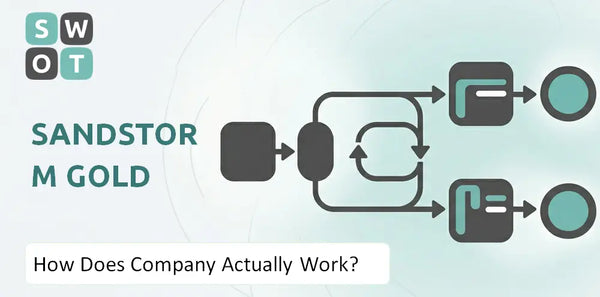
Sandstorm's revenue logic: upfront capital plus per-ounce delivery secures long-term cash flows and lowers capital intensity. See a focused asset review in Sandstorm Gold SWOT Analysis.
What Does Sandstorm Gold Actually Sell?
Sandstorm Gold Ltd. sells upfront, non-dilutive financing to junior and mid-tier miners through streaming and royalty contracts rather than physical gold; customers get capital today while Sandstorm secures rights to future mine production or a percentage of gross revenue.
 What Sandstorm Gold Offers
Sandstorm Gold provides precious-metals streaming and royalty agreements: upfront cash to miners in exchange for rights to purchase a portion of future gold (or receive a percentage of gross revenue) at a negotiated discount or fixed price.
Who It Serves
Primary customers are junior and mid-tier mining companies needing capital for development, expansion, or permitting; investors and analysts use Sandstorm Gold data to evaluate streaming and royalty investments.
Value It Delivers
Miners receive immediate, non-dilutive funding that avoids issuing equity or high-interest loans; Sandstorm secures long-term, low-cost access to metal supply, supporting predictable revenue and cash flow from a diversified portfolio of streams and royalties.
Why Customers Choose Sandstorm Gold
Miners choose Sandstorm Gold Company because streaming and royalty deals are faster and less dilutive than equity raises, cheaper than some debt, and flexible across project timelines; investors value Sandstorm Gold business model for steady cash flow exposure to gold prices with portfolio diversification.
At year-end 2025 Sandstorm Gold reported a portfolio of over 140 streams and royalties across 70+ counterparties, with 2025 attributable production totaling approximately 105,000 gold equivalent ounces and revenue of roughly US$220 million, driven by streaming agreements that deliver cash per ounce at below-market effective prices; see related analysis in Who Owns Sandstorm Gold Company for ownership and structural context.
Sandstorm Gold SWOT Analysis
- Complete SWOT Breakdown
- Fully Customizable
- Editable in Excel & Word
- Professional Formatting
- Investor-Ready Format

How Does Sandstorm Gold Run Day to Day?
Sandstorm Gold Ltd. runs like a compact private equity firm: a lean team under 30 professionals focuses on sourcing, underwriting, and monitoring streaming and royalty investments while third-party miners handle operations and environmental liabilities.

Operating model: lean investor-manager
Sandstorm Gold sources and funds precious-metal streams and royalties, then delegates mining and processing to operators. In-house geologists and engineers perform technical due diligence and deal structuring before execution.
Service delivery: royalty and stream contracts
The company provides upfront capital to mines in exchange for future metal or revenue deliveries; buyers and refiners access bullion downstream while Sandstorm receives royalty/stream receipts reported monthly or quarterly.
Production oversight: external operators
Sandstorm does not run mines; it reviews operator production reports and metallurgical recovery metrics across its portfolio to validate deliveries and cash flows from streams and royalties.
Sales channels: cash flow collection and metal sales
Revenue flows from third-party operators to Sandstorm per contract terms; the firm may sell physical metal, hedge portions, or recognize cash payments depending on each streaming agreement.
Key assets and partnerships: diversified global portfolio
Sandstorm Gold holds over 250 streams and royalties across five continents and partners with mid-tier and major mining operators; IT systems track production, pricing, and counterparty performance.
Practical enabler: repeatable underwriting process
Daily efficiency comes from a standardized technical due diligence and deal template that scales across jurisdictions and commodities, reducing transaction friction and legal complexity.

Day-to-day mechanics of Sandstorm Gold operations
Sandstorm Gold operates day-to-day as an asset manager of streaming and royalty investments: underwriting new agreements, tracking operator production against forecasts, and collecting contract receipts while keeping a compact corporate cost base.
- Core operating model: capital provider for streaming and royalty investments with outsource of mine operations
- Product delivery: receives metal or cash per streaming agreements; monetizes via sales, hedges, or direct cash receipts
- Main support: portfolio of 250 plus streams and royalties, operator reporting systems, and a technical team of geologists/engineers
- Efficiency driver: repeatable due diligence, standardized contracts, and low headcount under 30 professionals
For a strategic view linking daily operations to growth and capital allocation, see Where Sandstorm Gold Company Is Going
Sandstorm Gold PESTLE Analysis
- Covers All 6 PESTLE Categories
- No Research Needed – Save Hours of Work
- Built by Experts, Trusted by Consultants
- Instant Download, Ready to Use
- 100% Editable, Fully Customizable

How Does Money Come In at Sandstorm Gold?
Sandstorm Gold Ltd. monetizes mining assets via two channels: commodity streams, buying ounces at fixed low prices and selling at spot, and Net Smelter Return (NSR) royalties, receiving a percentage of mine revenue regardless of costs. Both drive cash flow; higher spot gold expands stream margins while NSRs provide steady, cost-insulated royalties.
Primary revenue: gold streaming
Sandstorm Gold buys physical gold from partner mines at fixed prices, typically between 400 and 700 USD per ounce, then sells at market spot. When spot gold exceeds 2,700 USD per ounce the per-ounce spread becomes very large, driving outsized cash margins.
Additional revenue: NSR royalties
Sandstorm Gold receives Net Smelter Return royalties-fixed percentages of gross mine revenue-so payments scale with production and metal prices while remaining insulated from operator cost inflation.
Pricing and monetization model
Streaming is priced as per-ounce purchase agreements with upfront capital plus low per-ounce payments; NSRs are percentage-based royalties on gross revenue. Revenue is therefore a mix of volume-driven receipts and price-driven spread capture.
What drives revenue most
Spot gold price and attributable production volume are the top drivers: higher spot increases stream margins, while higher mine output raises both streamed ounces and NSR receipts. Portfolio mix of streams versus royalties also shifts cash flow volatility.
How money comes in at Sandstorm Gold
Sandstorm Gold turns capital into cash mainly by buying gold at fixed low per-ounce prices and by collecting percentage royalties on gross mine revenue; higher spot gold in early 2025 delivered exceptional cash margins. In 2025 the company reported record cash operating margins of between 2,509 and 2,981 USD per attributable gold equivalent ounce, pushing 2025 revenue estimates above 230 million USD.
- Primary stream: buy ounces at 400-700 USD/oz, sell at spot
- Secondary: NSR royalties-fixed % of gross revenue
- Monetization: upfront capital + low per-ounce fees and ongoing percentage royalties
- Top driver: spot gold price and attributable production volume
Further context and investor-focused detail on Sandstorm Gold business model explained is available in this company overview: What Sandstorm Gold Company Stands For
Sandstorm Gold SOAR Analysis
- Complete SOAR Analysis
- Effortlessly Communicate Your Business Strategy
- Investor-Ready Format
- 100% Editable and Customizable
- Clear and Structured Layout

What Makes Sandstorm Gold's Model Strong or Fragile?
Sandstorm Gold Ltd.'s model is powerful due to extreme capital efficiency and high margins, but fragile because it relies entirely on third – party operators for production and political stability. Its strengths include an >80% corporate EBITDA margin and diversified cash flows; its vulnerability is counterparty execution risk and project-specific geopolitical exposure.
Capital efficiency and margin resilience
Sandstorm Gold's gold streaming company model converts upfront capital into long – dated future ounces at low ongoing cost, producing a corporate EBITDA margin exceeding 80% in 2025, insulating revenue from miners' rising labor and fuel costs.
Portfolio diversification of streams and royalties
The portfolio spans dozens of cash – flowing streams and royalties across multiple jurisdictions, so no single mine typically drives revenues; this long tail reduces company – level production volatility and smooths cash flow receipts.
Dependence on third – party operators
Sandstorm Gold Company holds financial rights but no operational control; if an operator suffers a geological disaster, operational misstep, or asset seizure, Sandstorm cannot directly remedy production shortfalls.
Durability after acquisition agreement
The July 2025 agreement to be acquired by Royal Gold Inc. in a USD 3.5 billion all – share transaction materially lowers counterparty concentration risk by folding Sandstorm Gold into a larger streaming and royalty platform while preserving upside to gold prices.
Net assessment of strength versus fragility
Sandstorm Gold business model works because it trades operating risk for capital exposure, delivering high EBITDA margins and diversified cash flows; it can be weakened only by partner execution failures or geopolitical events that halt royalties or streams.
- Extreme capital efficiency yielding a corporate EBITDA margin > 80%
- Wide portfolio of streams and royalties as the key commercial asset
- Complete dependence on third – party operator execution and sovereign risk
- Post – July 2025 acquisition deal makes the model more resilient by reducing standalone counterparty exposure
Sandstorm Gold VRIO Analysis
- Covers VRIO Analysis in Details
- Structured for Consultants, Students, and Founders
- 100% Editable in Microsoft Word & Excel
- Instant Digital Download – Use Immediately
- Compatible with Mac & PC – Fully Unlocked

Related Blogs
- What Does Sandstorm Gold Company Stand For?
- How Did Sandstorm Gold Company Become What It Is Today?
- Who Owns Sandstorm Gold Company and Why Does It Matter?
- How Does Sandstorm Gold Company Sell Its Products and Services?
- Where Is Sandstorm Gold Company Going Next?
- Who Does Sandstorm Gold Company Serve?
- Who Does Sandstorm Gold Company Compete With?
Frequently Asked Questions
Sandstorm Gold sells upfront financing through streaming and royalty contracts, not physical gold. It gives miners capital today in exchange for rights to future mine production or a percentage of gross revenue at a negotiated discount or fixed price. That structure helps miners fund development, expansion, or permitting without issuing equity.
Disclaimer
All information, articles, and product details provided on this website are for general informational and educational purposes only. We do not claim any ownership over, nor do we intend to infringe upon, any trademarks, copyrights, logos, brand names, or other intellectual property mentioned or depicted on this site. Such intellectual property remains the property of its respective owners, and any references here are made solely for identification or informational purposes, without implying any affiliation, endorsement, or partnership.
We make no representations or warranties, express or implied, regarding the accuracy, completeness, or suitability of any content or products presented. Nothing on this website should be construed as legal, tax, investment, financial, medical, or other professional advice. In addition, no part of this site - including articles or product references - constitutes a solicitation, recommendation, endorsement, advertisement, or offer to buy or sell any securities, franchises, or other financial instruments, particularly in jurisdictions where such activity would be unlawful.
All content is of a general nature and may not address the specific circumstances of any individual or entity. It is not a substitute for professional advice or services. Any actions you take based on the information provided here are strictly at your own risk. You accept full responsibility for any decisions or outcomes arising from your use of this website and agree to release us from any liability in connection with your use of, or reliance upon, the content or products found herein.