
How does Outbrain connect publishers and advertisers through content recommendation and monetization?
Outbrain matches premium publishers with advertisers via native content recommendation and programmatic placement, earning revenue from CPC and performance fees. In 2025 it reported growing advertiser spend and a shift toward outcome-based deals, signaling scalable ad-tech margins.
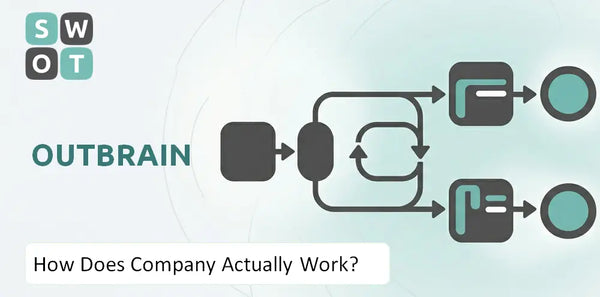
Outbrain's catalog model routes intented traffic to publishers while selling performance and discovery formats to advertisers, supporting recurring CPC revenues and yield optimization through algorithms. See a product insight: Outbrain SWOT Analysis
What Does Outbrain Actually Sell?
Outbrain sells native advertising placements and content-distribution services that place sponsored articles, videos, and product recommendations inside editorial feeds and premium video/CTV inventory, delivering discovery-stage audiences in a brand-safe environment.
 Core Products and Platform
Outbrain native advertising and content discovery platform distributes articles, videos, and product recommendation units across more than 10,000 partner publishers and, after the February 2025 Teads acquisition for approximately $900,000,000, added premium video and Connected TV (CTV) placements to its feed and full-funnel stack.
Main Customer Segments
Advertisers (performance and brand), agencies, and publishers use Outbrain for distribution, monetization, and audience engagement. Publishers integrate the Outbrain ads platform to earn revenue while advertisers target discovery-mode users with native ads and video/CTV campaigns.
Value Delivered
Customers gain higher engagement and viewability by placing content where users are in discovery mode, increasing click-through and downstream conversions versus interruptive banner ads. Outbrain combines performance bidding with brand-safe premium video/CTV to drive both awareness and direct response.
Why Clients Choose Outbrain
Clients pick Outbrain for its broad publisher network, content-native placements, and expanded video/CTV inventory after the Teads deal, plus targeting options and reporting that support performance campaigns and brand lift studies; see Who Outbrain Company Serves for customer examples and use cases: Who Outbrain Company Serves
Outbrain SWOT Analysis
- Complete SWOT Breakdown
- Fully Customizable
- Editable in Excel & Word
- Professional Formatting
- Investor-Ready Format

How Does Outbrain Run Day to Day?
Outbrain runs daily as an AI-driven real-time marketplace that matches publisher inventory with advertiser demand via recommendation widgets and a Demand-Side Platform (DSP), routing impressions, bids, and creatives to maximize CTR while preserving editorial quality.

AI-driven matching engine
Outbrain operates a machine-learning matching engine that analyzes page context and user behavior to select native advertising and content recommendations in real time for publishers and advertisers.
Product and service delivery via widgets and DSP
Publishers integrate recommendation widgets that populate feeds; advertisers use the DSP to set budgets, audience targets, and creative. The DSP reported a 45 percent increase in advertiser spend in FY 2024.
Development and data sourcing
Data scientists and engineers continuously train models on billions of signals from site behavior, contextual analysis, and third-party data to refine targeting and CTR optimization across formats including Moments vertical video.
Sales channels and distribution
Main distribution runs through publisher partnerships, programmatic DSP inventory, and direct-sold deals; Moments is live on over 70 major publishers including Fox News and Axel Springer to scale video reach.
Key assets, systems, and partnerships
Core assets include the recommendation widget, DSP, ML models, revenue-share publisher contracts, and integrations with analytics platforms; strategic partnerships accelerate APAC and LATAM expansion in 2025-2026.
Practical drivers of efficiency
Real-time bidding, automated creative testing, and feed-level prediction of CTR ensure scalable monetization; editorial controls and quality filters preserve publisher trust and long-term yield.

Daily mechanics of the Outbrain marketplace
Operations hinge on continuous model scoring of page and user signals, live auctioning via the DSP, and immediate widget rendering on publisher pages to serve native recommendations and ads.
- AI-driven marketplace matching Outbrain native advertising to contextual and behavioral signals
- Delivery through publisher widgets and the Outbrain ads platform DSP with campaign controls and bidding
- Publisher network, Moments video distribution, and analytics integrations power scale and reporting
- Automated bidding, CTR optimization, and quality controls keep the model efficient and revenue-generating
See related governance and values context in this article What Outbrain Company Stands For
Outbrain PESTLE Analysis
- Covers All 6 PESTLE Categories
- No Research Needed – Save Hours of Work
- Built by Experts, Trusted by Consultants
- Instant Download, Ready to Use
- 100% Editable, Fully Customizable

How Does Money Come In at Outbrain?
Outbrain generates revenue mainly by charging advertisers when users click promoted content via a Cost-Per-Click (CPC) model and sharing most of that payment with publishers as Traffic Acquisition Cost (TAC); video/CTV CPM sales are an expanding, higher-margin complement.
Main revenue stream: CPC native advertising
Outbrain native advertising and content discovery placements drive the bulk of revenue: advertisers pay per click and Outbrain routes traffic to publisher sites, taking the spread after publisher TAC is paid. This CPC logic aligns advertiser spend with measurable user engagement.
Additional revenue streams: CPM video, CTV, and premium formats
The company is shifting more spend into CPM-priced video and CTV inventory, which grew over 100 percent year-over-year in Q1 2025, and into platform services and referral partnerships for publishers and advertisers.
Pricing and monetization model: CPC with CPM mix
Primary pricing is CPC where advertisers bid for clicks; higher-margin CPM (cost per mille) products price video and CTV by impressions. Outbrain pools advertiser spend, pays publishers TAC, and retains the remainder as gross margin.
What drives revenue most: scale and inventory mix
Volume of publisher traffic, advertiser demand for native reach, and a shift toward CPM video/CTV mix drive revenue. Integration with Teads lifted consensus 2025 revenue forecasts to about 1.45 billion dollars.
How Money Comes In
Outbrain turns advertiser demand into revenue by charging for clicks and impressions, sharing ~73.5 percent of 2024 revenue as TAC, keeping the rest as gross profit; scale gains and a rising CPM mix are boosting 2025 outlooks.
- Main revenue stream: CPC native advertising and content discovery placements
- Secondary monetization: CPM video and CTV inventory plus platform services
- Pricing model: advertiser CPC bids plus growing CPM products for video/CTV
- Strongest revenue driver: publisher traffic scale, advertiser demand, and inventory mix shift toward higher-margin video/CTV
For company history and context on how Outbrain evolved its model, see History of Outbrain Company Explained.
Outbrain SOAR Analysis
- Complete SOAR Analysis
- Effortlessly Communicate Your Business Strategy
- Investor-Ready Format
- 100% Editable and Customizable
- Clear and Structured Layout

What Makes Outbrain's Model Strong or Fragile?
Outbrain's model is strong because of scale and a shift to omnichannel revenue, but fragile due to heavy acquisition debt and a structural threat from AI-driven no-click search. Strengths: audience reach and advertiser relationships; vulnerabilities: long-term debt of $628,000,000 and declining publisher traffic from AI search.
Scale and Omnichannel Moat
Outbrain's reach to 2.2 billion consumers and direct deals with 20,000 advertisers lets the Outbrain ads platform sell both performance and brand solutions across native feed, CTV, and AI-driven placements, diversifying revenue beyond classic Outbrain native advertising.
Proprietary Distribution and Targeting
Outbrain's content discovery algorithms, publisher relationships, and programmatic stack power how Outbrain recommendations are generated and enable granular audience targeting, supporting campaign bidding strategies and measurement in performance metrics and reporting.
Balance Sheet and Integration Risk
The Teads acquisition left Outbrain with approximately $628,000,000 in long-term debt; management targets synergies of $65,000,000-$75,000,000 annually by 2026 to cover debt service and justify the deal economics.
Inventory Exposure to No-Click Search
The rise of AI-powered search summaries (Perplexity, Google AI Overviews) drives no-click behavior, reducing organic publisher sessions and compressing available inventory for Outbrain for publishers, which could push CPMs down and hurt Outbrain content discovery revenue.
Net Strength vs. Fragility
Outbrain works because scale and omnichannel product expansion can capture larger brand budgets; it is weakened if AI search permanently erodes publisher traffic or if synergies from Teads integration miss targets needed to service $628,000,000 in debt.
- Massive audience reach: 2.2 billion consumers
- Key capability: direct relationships with 20,000 advertisers
- Primary constraint: debt from Teads acquisition requiring $65-75 million annual synergies by 2026
- Durability: exposed in 2025/2026-success hinges on AI-driven efficiency gains and CTV growth outpacing publisher traffic erosion
For implementation and sales context, see How Outbrain Company Sells
Outbrain VRIO Analysis
- Covers VRIO Analysis in Details
- Structured for Consultants, Students, and Founders
- 100% Editable in Microsoft Word & Excel
- Instant Digital Download – Use Immediately
- Compatible with Mac & PC – Fully Unlocked

Related Blogs
- What Does Outbrain Company Stand For?
- How Did Outbrain Company Become What It Is Today?
- Who Owns Outbrain Company and Why Does It Matter?
- How Does Outbrain Company Sell Its Products and Services?
- Where Is Outbrain Company Going Next?
- Who Does Outbrain Company Serve?
- Who Does Outbrain Company Compete With?
Frequently Asked Questions
Outbrain sells native advertising placements and content-distribution services. Its offerings place sponsored articles, videos, and product recommendations inside editorial feeds and premium video/CTV inventory, helping advertisers reach discovery-stage audiences in a brand-safe environment while publishers monetize their pages.
Disclaimer
All information, articles, and product details provided on this website are for general informational and educational purposes only. We do not claim any ownership over, nor do we intend to infringe upon, any trademarks, copyrights, logos, brand names, or other intellectual property mentioned or depicted on this site. Such intellectual property remains the property of its respective owners, and any references here are made solely for identification or informational purposes, without implying any affiliation, endorsement, or partnership.
We make no representations or warranties, express or implied, regarding the accuracy, completeness, or suitability of any content or products presented. Nothing on this website should be construed as legal, tax, investment, financial, medical, or other professional advice. In addition, no part of this site - including articles or product references - constitutes a solicitation, recommendation, endorsement, advertisement, or offer to buy or sell any securities, franchises, or other financial instruments, particularly in jurisdictions where such activity would be unlawful.
All content is of a general nature and may not address the specific circumstances of any individual or entity. It is not a substitute for professional advice or services. Any actions you take based on the information provided here are strictly at your own risk. You accept full responsibility for any decisions or outcomes arising from your use of this website and agree to release us from any liability in connection with your use of, or reliance upon, the content or products found herein.