
How does Liquidity Services convert idle corporate and government assets into repeatable revenue through auctions, data, and logistics?
Liquidity Services turns wasting assets into cash via marketplaces, logistics, and analytics; in 2025 it reported growing marketplace take-rates and improved gross margins, signaling a shift toward higher-margin software and services.
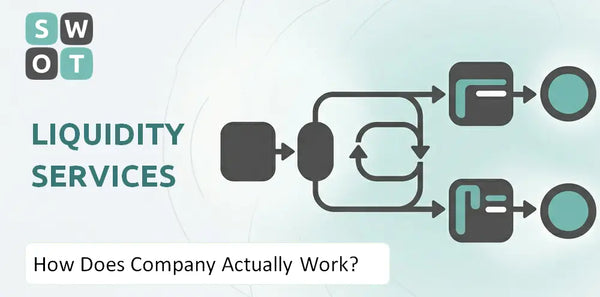
Its platform combines inventory ingestion, valuation algorithms, and managed logistics so sellers realize faster cash recovery and buyers access vetted surplus; seller fees plus technology subscriptions diversify revenue.
See a focused product perspective: Liquidity Services SWOT Analysis
What Does Liquidity Services Actually Sell?
Liquidity Services sells disposition solutions: online auctions, buy-now listings, and remarketing services that convert surplus machinery, government vehicles, and retail returns into cash. Sellers get turnkey asset recovery and buyers access a global pipeline of discounted goods across 600+ categories.
 Core offerings: disposition solutions and remarketing
Liquidity Services operates an online asset auction platform and managed-sell programs that include appraisal, professional photography, digital marketing, secure payment processing, and logistics coordination. The firm handles surplus asset liquidation and industrial asset remarketing across machinery, fleet, electronics, and retail returns.
Who it serves: public and private sector asset owners
Customers include federal, state, and local government agencies, Fortune 1000 corporations, manufacturers, retailers, and small businesses needing reverse logistics and remarketing. Buyers are institutional resellers, refurbishers, dealers, and retail consumers seeking discounted surplus and government surplus sales.
Value delivered: liquidity, efficiency, and recovery
Sellers receive operational lift: reduced staffing, faster cycle times, and higher net recovery-Liquidity Services reported handling over $1.2 billion in managed transactions in fiscal 2025 and increased average recovery rates versus baseline liquidation methods. Buyers gain vetted access to discounted inventory and transparent bidding.
Why customers choose it: scale, compliance, and channel reach
Clients pick Liquidity Services for integrated end-to-end disposition: a regulated platform that supports government compliance, wide buyer reach across 600+ asset categories, and measurable KPIs-typically faster sell-through and predictable payout timelines compared with ad hoc sales. See a market comparison in Who Liquidity Services Company Competes With.
Liquidity Services SWOT Analysis
- Complete SWOT Breakdown
- Fully Customizable
- Editable in Excel & Word
- Professional Formatting
- Investor-Ready Format

How Does Liquidity Services Run Day to Day?
Liquidity Services runs day to day as a multi-marketplace asset remarketing platform that lists surplus government and industrial assets, matches them to buyers, and manages end-to-end disposition through consignment or outright purchase.

Operating model: multi-marketplace remarketing
Liquidity Services segments supply across specialized marketplaces - GovDeals for public sector, AllSurplus for industrial assets, and Machinio for equipment search - and runs a unified backend to route inventory, bidders, and payment flows.
Product and service delivery: digital listing to removal
Sellers onboard via a Seller Asset Management tool; AI-assisted verification and automated lotting generate listings that reach a buyer base of over 6,000,000 registered users, creating competitive online auctions and fixed-price offers.
Production, sourcing, development: data and AI-driven workflows
Assets are categorized using AI and human verification; in late 2024 AI automated lotting and description tools reduced listing time by 40%, raising throughput and lowering cost per lot.
Sales channels and distribution: marketplaces and direct purchase
Inventory moves to buyers via public online auctions, private negotiated sales, or buyback offers where Liquidity Services purchases inventory upfront to capture margin and speed turnaround.
Key assets, systems, partnerships: platform, logistics, compliance
Core assets include the Seller Asset Management system, AI description/lotting, payment escrow, and third-party logistics partners for removal; government agency integrations support compliant government surplus sales.
What makes it work: scale, data, and flexible commercial models
Scale of buyers (> 6,000,000), data-driven pricing, and the mix of consignment and purchase models deliver high recovery rates and predictable margins for surplus asset liquidation.

Daily operations and lifecycle management
Day to day Liquidity Services ingests seller inventory, AI-categorizes and lists lots, runs auctions to a 6M+ buyer base, secures payment, and coordinates asset removal under consignment or purchase agreements.
- Core operating model: multi-marketplace online asset auction platform and purchase model
- Product delivery: AI-assisted listing, online bidding, escrow payments, and coordinated removal
- Main support: Seller Asset Management tool, AI lotting (launched late 2024), payment escrow, and third-party logistics partners
- Efficiency driver: 40% faster listing time from AI automation and a buyer pool exceeding 6,000,000 users
For more detail on sector focus and client segments see Who Liquidity Services Company Serves
Liquidity Services PESTLE Analysis
- Covers All 6 PESTLE Categories
- No Research Needed – Save Hours of Work
- Built by Experts, Trusted by Consultants
- Instant Download, Ready to Use
- 100% Editable, Fully Customizable

How Does Money Come In at Liquidity Services?
Liquidity Services brings cash in through commissions on consigned assets, principal resales, recurring SaaS subscriptions, and per-transaction fees; this mix blends variable marketplace take rates with predictable software income to monetize surplus asset liquidation and industrial asset remarketing.
Commission-driven Marketplaces: Core Revenue
Most revenue comes from marketplace commissions, where Liquidity Services charges a take rate typically between 5 percent and 15 percent by asset category; in fiscal 2025 this helped produce a record GMV of $1.57 billion and revenues of $476.7 million.
Principal Resale and SaaS: Additional Revenue Streams
Liquidity Services buys surplus inventory at discounts (principal resale) to capture higher margins, and it earns high-margin recurring SaaS revenue from platforms like Machinio that support industrial asset remarketing and online asset auction platform functions.
Pricing and Monetization Model
Monetization mixes percentage-based commissions on final sale prices, fixed transaction fees (notably in GovDeals), one-time principal purchase/resale gains, and subscription fees for SaaS-so revenue is both volume- and recurring-driven.
What Drives Revenue Most
Volume and mix drive revenue: higher GMV and a larger share of commission-bearing sales lift top line, while GovDeals' fixed fees and the Machinio subscriptions add predictable margins; in 2025 GovDeals represented roughly 45 percent of GMV.
How Money Comes In
Liquidity Services converts demand into revenue by taking transaction commissions, charging fixed transaction fees, buying and reselling inventory, and collecting SaaS subscriptions-this mix produced $476.7 million in revenue on $1.57 billion GMV in fiscal 2025 and $121.2 million revenue with $18.1 million non-GAAP adjusted EBITDA in Q1 fiscal 2026.
- Marketplace commissions: percentage take rates by asset category (5-15 percent)
- Principal resale: buy low, resell higher on surplus inventory
- SaaS subscriptions: recurring high-margin revenue from Machinio
- Transaction fees and volume mix: GovDeals fixed fees drove ~45 percent of 2025 GMV
For context on corporate purpose and platform positioning see What Liquidity Services Company Stands For.
Liquidity Services SOAR Analysis
- Complete SOAR Analysis
- Effortlessly Communicate Your Business Strategy
- Investor-Ready Format
- 100% Editable and Customizable
- Clear and Structured Layout

What Makes Liquidity Services's Model Strong or Fragile?
Liquidity Services' model is strong from network effects and an asset-light, tech-enabled structure but fragile to macro shocks and inventory obsolescence. Key strengths: >6 million buyers, >16,000 sellers, zero financial debt and $181.4 million cash early 2026; key dependencies: industrial production cycles and interest rates.
Network Effects and Liquidity Moat
Large buyer and seller pools deepen liquidity for surplus asset liquidation and industrial asset remarketing, raising conversion rates and keeping bid spreads tight. Scale makes it costly for new online asset auction platform entrants to replicate the marketplace dynamics.
Technology-First, Asset-Light Operations
Shift to self-service and SaaS-like tooling lowers fulfillment cost per lot and increases operating leverage; management expects self-service growth to lift new seller accounts by 15 percent through 2026, expanding margins.
Concentration on Industrial Cycles
Supply of surplus assets tracks industrial production and corporate capex; prolonged slowdowns or high rates compress both supply and buyer demand, reducing GMV and revenue, as evidenced by a 1 percent revenue decline in Q1 2026 despite GMV growth.
Model Durability in 2025/2026
Durable in neutral-to-strong cycles due to a fortress balance sheet and ESG tailwinds tied to circular economy trends; exposed in deep recessions where surplus supply and buyer appetite both fall and aging inventory risks accelerate.
Core Verdict on Strengths and Vulnerabilities
Liquidity Services works because scale, marketplace liquidity, and an asset-light, tech-led pivot drive high operating leverage; it weakens when macro activity and interest rates compress surplus flows and buyer demand.
- Massive marketplace: >6 million buyers and >16,000 sellers create a durable liquidity moat
- Key capability: self-service platform and reverse logistics and remarketing reduce fulfillment costs and improve recovery rates
- Main dependency: industrial production cycles and interest-rate-driven capital spending
- Resilience: appears resilient in 2025/2026 due to $181.4 million cash and zero financial debt, but exposed to severe macro downturns and inventory obsolescence
For institutional background on ownership and corporate history, see Who Owns Liquidity Services Company
Liquidity Services VRIO Analysis
- Covers VRIO Analysis in Details
- Structured for Consultants, Students, and Founders
- 100% Editable in Microsoft Word & Excel
- Instant Digital Download – Use Immediately
- Compatible with Mac & PC – Fully Unlocked

Related Blogs
- What Does Liquidity Services Company Stand For?
- How Did Liquidity Services Company Become What It Is Today?
- Who Owns Liquidity Services Company and Why Does It Matter?
- How Does Liquidity Services Company Sell Its Products and Services?
- Where Is Liquidity Services Company Going Next?
- Who Does Liquidity Services Company Serve?
- Who Does Liquidity Services Company Compete With?
Frequently Asked Questions
Liquidity Services sells disposition solutions, not traditional retail products. Its core offerings include online auctions, buy-now listings, and remarketing services that turn surplus machinery, government vehicles, electronics, and retail returns into cash for sellers.
Disclaimer
All information, articles, and product details provided on this website are for general informational and educational purposes only. We do not claim any ownership over, nor do we intend to infringe upon, any trademarks, copyrights, logos, brand names, or other intellectual property mentioned or depicted on this site. Such intellectual property remains the property of its respective owners, and any references here are made solely for identification or informational purposes, without implying any affiliation, endorsement, or partnership.
We make no representations or warranties, express or implied, regarding the accuracy, completeness, or suitability of any content or products presented. Nothing on this website should be construed as legal, tax, investment, financial, medical, or other professional advice. In addition, no part of this site - including articles or product references - constitutes a solicitation, recommendation, endorsement, advertisement, or offer to buy or sell any securities, franchises, or other financial instruments, particularly in jurisdictions where such activity would be unlawful.
All content is of a general nature and may not address the specific circumstances of any individual or entity. It is not a substitute for professional advice or services. Any actions you take based on the information provided here are strictly at your own risk. You accept full responsibility for any decisions or outcomes arising from your use of this website and agree to release us from any liability in connection with your use of, or reliance upon, the content or products found herein.