
How does Inter&Co actually convert customer activity into revenue across its super app?
Inter&Co bundles payments, credit, investing, and commerce in one platform to drive repeat engagement and monetization. In 2025 it reported rapid fee income growth and rising payment volumes, supporting its push to 60 million customers by 2027. Inter&Co SWOT Analysis
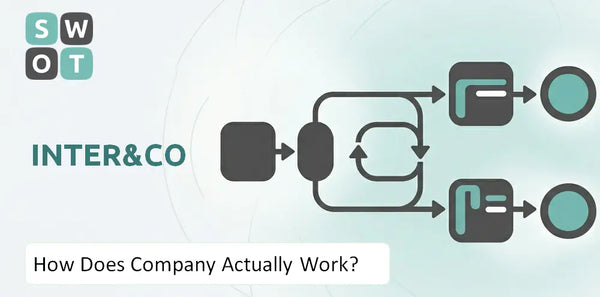
Inter&Co earns interchange, lending spreads, and subscription fees from integrated services, keeping costs low via cloud-native ops. Recent 2025 metrics show improving unit economics and a falling cost-to-income ratio.
What Does Inter&Co Actually Sell?
Inter&Co company sells a unified digital gateway combining a free checking account with integrated banking, brokerage, insurance, and a curated retail marketplace, so users handle spending, investing, borrowing, and shopping in one app. The platform packages financial products and lifestyle services into a single interface that replaces multiple specialist providers.
 Unified financial and lifestyle platform
Inter&Co works as a single digital platform offering deposits, payments, low-fee brokerage, term and index insurance, mortgages and a marketplace for goods and services. The entry point is a free digital checking account that unlocks integrated credit, investing, and retail features.
Main customer segments served
Inter&Co serves retail consumers, digitally active millennials and Gen Z, SMBs seeking embedded finance, and wealth-aspirational users who want retail investing without high minimums. It also targets partners and merchants for marketplace integration and API-based fintech partners.
Value delivered to customers
Customers get consolidated money management, lower friction onboarding, unified statements, and cross-product incentives such as cashback, sweep investments, and bundled insurance pricing. Inter&Co reduces the typical time to open accounts and link services from days to under 10 minutes in many cases.
Why customers pick Inter&Co
Users choose Inter&Co because it replaces multiple apps with one synchronized ledger, offers low-cost brokerage access (sub-$5 trades in base tier as of 2025 pricing), embedded credit lines tied to account behavior, and a marketplace curated for relevance. For details on user segments see Who Inter&Co Company Serves.
Inter&Co SWOT Analysis
- Complete SWOT Breakdown
- Fully Customizable
- Editable in Excel & Word
- Professional Formatting
- Investor-Ready Format

How Does Inter&Co Run Day to Day?
Inter&Co company runs as a cloud-native, branchless super app focused on rapid digital onboarding and high engagement; day-to-day work centers on real-time data, personalized offers, and integrated retail partnerships to drive transactions and retention.

Cloud-native operating model
Inter&Co works as a cloud-first, branchless platform that routes customer flows through a single super app, using microservices to scale features and keep overhead low.
Product and service delivery via super app
Products are delivered digitally: instant account opening, in-app payments, lending offers, and a retail mall; the app reported up to 15,000,000 daily logins at peak engagement.
Development and data-driven productization
Inter&Co builds features via agile squads, continuous deployment, and a data analytics stack that hyper-personalizes offers under the Inter by Design philosophy.
Sales channels and distribution
Distribution runs inside the app and through embedded partnerships: integrated third-party retailers populate an internal shopping mall while APIs enable merchant integrations and co-branded offers.
Key assets, systems, and partnerships
Critical assets include the cloud platform, analytics/ML stack, payment rails, and merchant network; strategic retail partners function as storefronts while Inter&Co provides financial services and distribution.
Why the model works in practice
The model scales because of a lean cost structure: Inter&Co maintained an efficiency ratio of 45.5% as of late 2025, enabling competitive pricing and higher marketing-driven growth.

Daily operations and core workflow
Day-to-day operations run on continuous user-event processing: onboarding, personalized product pushes, transactions through the in-app mall, and merchant reconciliation-backed by automated fraud controls and real-time analytics.
- The core operating model: cloud-native super app with microservices and Inter by Design data personalization.
- Product delivery: instant digital onboarding, in-app wallets, lending, and a shopping mall integrating third-party retailers.
- Main support systems: analytics/ML, payment rails, API integrations, and merchant partnerships; see Who Inter&Co Company Competes With for context.
- Why it's efficient: 15,000,000 daily logins and an efficiency ratio of 45.5% in late 2025 lower unit costs and enable aggressive cross-sell.
Inter&Co PESTLE Analysis
- Covers All 6 PESTLE Categories
- No Research Needed – Save Hours of Work
- Built by Experts, Trusted by Consultants
- Instant Download, Ready to Use
- 100% Editable, Fully Customizable

How Does Money Come In at Inter&Co?
Inter&Co company earns money through three engines: net interest income from lending versus deposits, fee-based services like brokerage and insurance, and marketplace commissions on sales flowing through its platform. These streams combined drove net revenues to R$ 8.4 billion and net profit to R$ 1.31 billion in 2025.
Net Interest Income: Core Lending Spread
Net interest income is the primary revenue source, coming from the spread between low-cost deposits and loan yields. The credit portfolio reached R$ 48.3 billion by end-2025, with Private Payroll loans and Mortgages concentrated to maximize stable yield and credit margin.
Fee Income: Services and Transactions
Fee-based income includes brokerage commissions, insurance distribution fees, and FX transaction margins. These fees diversify revenue away from interest rate cycles and scale with customer transaction volume and assets under custody.
Marketplace Commissions and Platform Take Rate
The integrated shop and marketplace generate commission income on gross merchandise value (GMV) passing through Inter&Co services. Commissions rise with platform adoption and cross-selling of Inter&Co services to marketplace merchants and buyers.
What Drives Revenue Most
Scale of the credit portfolio, loan mix (payroll and mortgages), and platform activity are the main drivers; higher credit balances and marketplace GMV directly lift net interest income and commission fees. Customer retention and product penetration also boost fee income per user.
How Money Comes In at Inter&Co
Inter&Co works by converting customer deposits and platform activity into interest margin, fees, and marketplace commissions; this diversified mix produced R$ 8.4 billion in net revenues and R$ 1.31 billion net profit in 2025.
- Net interest income from a R$ 48.3 billion credit portfolio
- Fee income from brokerage, insurance distribution, and FX
- Commission model on marketplace GMV and platform transactions
- Primary revenue driver: credit scale and product mix (payroll loans, mortgages)
For context on strategic direction and platform initiatives that affect monetization, see Where Inter&Co Company Is Going.
Inter&Co SOAR Analysis
- Complete SOAR Analysis
- Effortlessly Communicate Your Business Strategy
- Investor-Ready Format
- 100% Editable and Customizable
- Clear and Structured Layout

What Makes Inter&Co's Model Strong or Fragile?
Inter&Co company's model is strong for its operational leverage and ecosystem stickiness but fragile due to Brazil macro sensitivity and volatile non-performing loans (2-8 percent historically). Key strengths: consolidated services lower acquisition cost and raise revenue per active customer; vulnerability: interest-margin pressure from larger neobanks and concentration risks.
Operational leverage and ecosystem stickiness
Inter&Co business model gains from cross-selling: bundled Inter&Co services increase average revenue per active customer and reduce Inter&Co customer acquisition cost. Shared tech and single sign-on raise retention and lower marginal costs as the loan book scales.
Key assets: tech platform, partnerships, and capital access
Inter&Co's core assets include a modular API stack for Inter&Co services, distribution partnerships with fintech platforms, and growing funding lines after the January 2026 U.S. banking branch approval, which diversifies geographic funding and reduces Brazil-only concentration.
Dependencies and constraints: macro, credit, and competition
Primary dependencies are Brazilian economic cycles (GDP, SELIC rate), wholesale funding costs, and credit underwriting quality; non-performing loans historically range between 2% and 8%, making earnings sensitive to economic shocks and underwriting slippage.
Durability in 2025-2026: strong scaling if disciplined
For 2025 and 2026 Inter&Co works from a scaling playbook: expanding the loan book toward the long-term target of R$ 100 billion can boost returns if credit discipline holds; failure to control NPLs or margin compression from neobank competition would expose fragility.
Core takeaway on strength versus fragility
Inter&Co company works by leveraging bundled Inter&Co services to cut acquisition costs and deepen customer value, while its fragility stems from macro dependence, NPL volatility, and margin pressure; the January 2026 U.S. branch approval materially reduces geographic concentration risk.
- Operational leverage from consolidated Inter&Co services lowers unit costs
- Modular API, partnerships, and U.S. branch improve scale and funding access
- Heavy exposure to Brazilian macro swings and NPL volatility (historical 2-8%)
- Model looks conditionally resilient in 2025-2026 if credit discipline sustains
Further reading on go-to-market and sales dynamics: How Inter&Co Company Sells
Inter&Co VRIO Analysis
- Covers VRIO Analysis in Details
- Structured for Consultants, Students, and Founders
- 100% Editable in Microsoft Word & Excel
- Instant Digital Download – Use Immediately
- Compatible with Mac & PC – Fully Unlocked

Related Blogs
- What Does Inter&Co Company Stand For?
- How Did Inter&Co Company Become What It Is Today?
- Who Owns Inter&Co Company and Why Does It Matter?
- How Does Inter&Co Company Sell Its Products and Services?
- Where Is Inter&Co Company Going Next?
- Who Does Inter&Co Company Serve?
- Who Does Inter&Co Company Compete With?
Frequently Asked Questions
Inter&Co sells a unified digital gateway that combines a free checking account with banking, brokerage, insurance, and a curated retail marketplace. Users can spend, invest, borrow, and shop inside one app instead of using multiple specialist providers.
Disclaimer
All information, articles, and product details provided on this website are for general informational and educational purposes only. We do not claim any ownership over, nor do we intend to infringe upon, any trademarks, copyrights, logos, brand names, or other intellectual property mentioned or depicted on this site. Such intellectual property remains the property of its respective owners, and any references here are made solely for identification or informational purposes, without implying any affiliation, endorsement, or partnership.
We make no representations or warranties, express or implied, regarding the accuracy, completeness, or suitability of any content or products presented. Nothing on this website should be construed as legal, tax, investment, financial, medical, or other professional advice. In addition, no part of this site - including articles or product references - constitutes a solicitation, recommendation, endorsement, advertisement, or offer to buy or sell any securities, franchises, or other financial instruments, particularly in jurisdictions where such activity would be unlawful.
All content is of a general nature and may not address the specific circumstances of any individual or entity. It is not a substitute for professional advice or services. Any actions you take based on the information provided here are strictly at your own risk. You accept full responsibility for any decisions or outcomes arising from your use of this website and agree to release us from any liability in connection with your use of, or reliance upon, the content or products found herein.