
How does Hydro One deliver regulated electricity transmission and distribution across Ontario while earning stable returns?
Hydro One operates Ontario's primary transmission and distribution network under OEB rate-setting, converting physical grid access into predictable cash flows. In 2025 Hydro One reported regulated ROE drivers from approved rate cases and capital spending of C$2.9B, underpinning steady revenue.
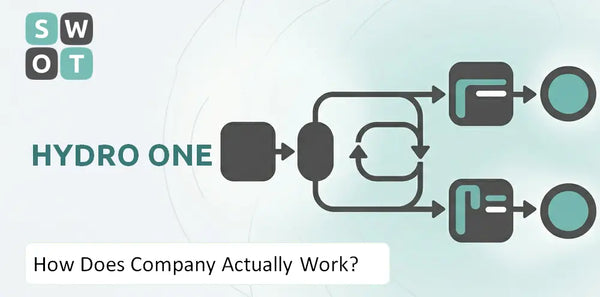
Hydro One earns fees for moving electricity, with revenues tied to allowed returns and capital additions; recent 2025 OEB rulings boosted recoverable base, supporting durability. See the Hydro One SWOT Analysis
What Does Hydro One Actually Sell?
Hydro One sells access to and transport of electricity rather than the power itself, offering transmission and local distribution services that guarantee a functioning grid and reliable delivery to end users.
 Core Offerings: Transmission and Distribution Access
Hydro One provides high-voltage transmission to move bulk power across Ontario and local distribution to deliver electricity to homes and businesses; its regulated service ensures continuous connectivity rather than selling kilowatt-hours. In 2025 Hydro One reported operating over 30,000 km of transmission lines and serving about 1.5 million distribution customers.
Who It Serves: Municipalities, Industry, Residents
Hydro One operations serve municipal utilities, large industrial sites, commercial customers, and approximately 1.5 million residential and business end users across Ontario. It also supports embedded local distribution companies and transmission-connected generators seeking reliable grid access.
Value Delivered: Guaranteed Availability and Connectivity
Customers pay for guaranteed grid availability, measured through reliability metrics such as SAIDI and SAIFI; Hydro One's regulated model converts infrastructure and maintenance into predictable service. In 2025 capital expenditures were focused on line upgrades and pole replacement, with the company planning multiyear spend to improve resilience and reduce outage minutes.
Why Customers Choose Hydro One
Customers rely on Hydro One transmission infrastructure and distribution networks because they offer wide geographic coverage, regulated rates set for cost recovery, and operational scale that supports quick restoration and maintenance. For context on market positioning and peers see Who Hydro One Company Competes With.
Hydro One SWOT Analysis
- Complete SWOT Breakdown
- Fully Customizable
- Editable in Excel & Word
- Professional Formatting
- Investor-Ready Format

How Does Hydro One Run Day to Day?
Hydro One runs daily as a large-scale asset operator that balances grid stability, maintenance, and capital delivery. Teams manage transmission and distribution networks, outage response, vegetation control, and a multi-billion-dollar investment program to replace assets and connect new industrial loads.

Operating model: centralized asset operations and regulated utility delivery
Hydro One operates a regulated transmission and distribution utility in Ontario, coordinating field crews, control centres, and capital planners to maintain reliability while recovering costs through regulated rates.
Service delivery: continuous electricity provision and outage response
Customers access electricity through physical connections to Hydro One lines; operations teams monitor the grid 24/7, dispatch crews for outages, and manage billing via regulated rate mechanisms.
Production/sourcing: asset replacement and connections for new loads
Hydro One does not generate power; it builds and maintains transmission and distribution infrastructure, placing 2.901 billion CAD of new assets into service in 2025 to replace aging equipment and support new industrial customers like EV battery plants.
Channels: physical network plus regulated customer interfaces
Electricity reaches customers via 126,000 circuit kilometres of distribution lines and 30,000 circuit kilometres of transmission lines; customers interact through connections, service requests, and outage reporting systems.
Key assets and systems: substations, control centres, and field workforce
Hydro One runs 312 transmission stations and ~1,000 distribution/regulating stations, SCADA and control-room systems for grid stability, and contractor networks for vegetation and pole replacement.
Why it works: regulated cost recovery and disciplined capital delivery
Regulated rates allow predictable cost recovery; disciplined project delivery-including a 3.366 billion CAD capital investment in 2025-keeps reliability high while enabling new industrial connections.

Daily mechanics: inspect, maintain, upgrade, and respond
Hydro One's day-to-day work is routine inspection, preventive vegetation management, outage response, and executing the capital program to modernize transmission infrastructure and expand capacity for new loads.
- Core model: regulated transmission and distribution asset operator focused on reliability and cost recovery
- Service delivery: continuous grid operation, customer connections, and 24/7 outage response
- Main support: substations, SCADA control rooms, field crews, and contractor networks for vegetation and pole work
- Efficiency driver: predictable regulated revenue and targeted capital spending-3.366 billion CAD invested in 2025
Further context on Hydro One operations and the company's purpose appears in this article: What Hydro One Company Stands For
Hydro One PESTLE Analysis
- Covers All 6 PESTLE Categories
- No Research Needed – Save Hours of Work
- Built by Experts, Trusted by Consultants
- Instant Download, Ready to Use
- 100% Editable, Fully Customizable

How Does Money Come In at Hydro One?
Hydro One brings in money mainly through regulated delivery charges on customer bills, split into transmission and distribution; revenue is driven by a rate-base model where allowed returns are applied to invested capital. In 2025, distribution made up most revenue and allowed ROE determined earned returns.
Primary revenue: Regulated delivery charges (distribution)
Hydro One electricity distribution accounts for the bulk of revenue, with 72 percent of 2025 revenues coming from distribution delivery charges regulated by the Ontario Energy Board (OEB); this underpins cash flow and capital recovery.
Additional revenue: Transmission and ancillary services
Transmission delivery contributed 27 percent of 2025 revenue, plus incremental income from connection fees, pole and line services, and limited non-regulated commercial activities tied to Hydro One services.
Pricing model: Rate-base with allowed ROE
Hydro One rates and billing follow a rate-base model where the OEB sets allowed return on equity; for 2025 the allowed ROE was 9.36 percent, so revenue scales with invested capital in transmission and distribution infrastructure.
Key revenue driver: Rate base and capital investment
What drives revenue most is the size of the rate base-more grid investment raises permitted revenue-and regulatory approvals for cost recovery, which together produced 2025 net income attributable to common shareholders of 1.339 billion CAD and EPS of 2.23 CAD.
How Hydro One Turns Infrastructure into Revenue
Hydro One monetizes capital investment by charging regulated delivery fees for distribution and transmission; the OEB sets rates and an allowed ROE, so higher rate base and approved capital programs directly increase permitted earnings.
- Distribution delivery charges are the main revenue stream, representing 72 percent of 2025 revenue.
- Transmission delivery and ancillary services provide secondary monetization, contributing 27 percent in 2025.
- Monetization model: rate-base returns set by the OEB with an allowed ROE of 9.36 percent for 2025.
- The strongest driver is the size and growth of the regulated rate base via infrastructure investment and approved capital spending.
For context on strategic direction and regulatory outlook see Where Hydro One Company Is Going and recent OEB filings on Hydro One operations and Hydro One transmission infrastructure.
Hydro One SOAR Analysis
- Complete SOAR Analysis
- Effortlessly Communicate Your Business Strategy
- Investor-Ready Format
- 100% Editable and Customizable
- Clear and Structured Layout

What Makes Hydro One's Model Strong or Fragile?
Hydro One's model is strong because it operates as a natural monopoly with predictable regulated returns, but it is fragile due to regulatory sensitivity and high interest-rate exposure. Strength comes from a 2025 rate base of 28.5 billion CAD and coverage of 75 percent of Ontario's land; fragility stems from OEB-set ROE and a net debt to capitalization of 59.5 percent as of December 31, 2025.
Natural Monopoly and Regulated Returns
Hydro One operations benefit from exclusive transmission and wide distribution footprint, limiting competition and supporting steady cash flows through regulated rates set by the Ontario Energy Board (OEB). Predictable allowed revenue tied to a large regulated asset base underpins capital recovery and financing plans.
Transmission and Distribution Assets
Hydro One transmission infrastructure and distribution networks include transmission lines, substations, and a massive pole-and-line inventory, enabling scale advantages in maintenance and outages response. Grid modernization programs (smart grid upgrades) and connections for industrial electrification strengthen long-term demand.
Regulatory and Political Dependence
Revenue and allowed ROE depend on OEB decisions and provincial policy; any regulatory shift on Hydro One rates and billing or political pressure to lower customer rates can compress margins and delay cost recovery. Rate case outcomes materially affect near-term cash flow and credit metrics.
Financial Leverage and Interest-Rate Sensitivity
Hydro One's debt-heavy capital structure creates sensitivity to market rates; with net debt to capitalization at 59.5 percent as of December 31, 2025, higher interest rates raise financing costs and pressure credit ratios, making investment pacing and dividend policy vulnerable.
Model Strength vs Fragility
Hydro One's model works because monopoly-scale plus a large regulated rate base deliver steady returns; it weakens if regulators cut allowed ROE or if rising rates push financing costs higher. Industrial electrification and mandated grid upgrades keep demand and capital spending elevated through 2026, supporting recoverable investments.
- Natural monopoly with 28.5 billion CAD 2025 rate base
- Extensive transmission infrastructure covering 75 percent of Ontario
- Dependence on OEB rate-setting and provincial policy
- Model resilient short-term (2025-2026) but exposed to regulatory shifts and interest-rate risk
Operational Strengths That Matter
Hydro One services include outage management, vegetation management, and pole replacement programs that reduce reliability risk; centralized operations and regional crews speed response. Strong asset management improves uptime and supports long-term rate cases focused on grid modernization.
Key Financial Metrics (2025)
Net debt to capitalization: 59.5 percent (Dec 31, 2025). Rate base: 28.5 billion CAD (2025). These numbers explain why Hydro One makes money via regulated returns on invested capital and rely on stable rate-setting.
For context on who Hydro One serves and geographic coverage, see Who Hydro One Company Serves.
Hydro One VRIO Analysis
- Covers VRIO Analysis in Details
- Structured for Consultants, Students, and Founders
- 100% Editable in Microsoft Word & Excel
- Instant Digital Download – Use Immediately
- Compatible with Mac & PC – Fully Unlocked

Related Blogs
- What Does Hydro One Company Stand For?
- How Did Hydro One Company Become What It Is Today?
- Who Owns Hydro One Company and Why Does It Matter?
- How Does Hydro One Company Sell Its Products and Services?
- Where Is Hydro One Company Going Next?
- Who Does Hydro One Company Serve?
- Who Does Hydro One Company Compete With?
Frequently Asked Questions
Hydro One sells access to and transport of electricity, not the power itself. Its core business is regulated transmission and local distribution, which keeps the grid connected and delivers electricity to homes, businesses, municipalities, and industrial sites across Ontario.
Disclaimer
All information, articles, and product details provided on this website are for general informational and educational purposes only. We do not claim any ownership over, nor do we intend to infringe upon, any trademarks, copyrights, logos, brand names, or other intellectual property mentioned or depicted on this site. Such intellectual property remains the property of its respective owners, and any references here are made solely for identification or informational purposes, without implying any affiliation, endorsement, or partnership.
We make no representations or warranties, express or implied, regarding the accuracy, completeness, or suitability of any content or products presented. Nothing on this website should be construed as legal, tax, investment, financial, medical, or other professional advice. In addition, no part of this site - including articles or product references - constitutes a solicitation, recommendation, endorsement, advertisement, or offer to buy or sell any securities, franchises, or other financial instruments, particularly in jurisdictions where such activity would be unlawful.
All content is of a general nature and may not address the specific circumstances of any individual or entity. It is not a substitute for professional advice or services. Any actions you take based on the information provided here are strictly at your own risk. You accept full responsibility for any decisions or outcomes arising from your use of this website and agree to release us from any liability in connection with your use of, or reliance upon, the content or products found herein.