
How does Hitachi's mix of OT, IT, and services generate recurring revenue for Hitachi?
Hitachi layers software and services onto heavy assets to boost margins and lock in customers; in 2025 Hitachi reported growing orders in its Digital Solutions and Energy businesses, signaling durable recurring revenue and higher SaaS-like margins.
Hitachi monetizes long-term service contracts and software licenses tied to equipment uptime and grid management; this raises lifetime customer value and smooths cyclical hardware revenue. See Hitachi SWOT Analysis
What Does Hitachi Actually Sell?
Hitachi sells integrated outcomes: software-driven industrial solutions anchored by physical infrastructure. The core is the Lumada digital platform plus high-value assets like HVDC systems and railway signaling, delivering uptime, efficiency, and decarbonization.
 What Hitachi Offers
Hitachi company bundles hardware and software: Lumada (data analytics, AI, IoT), Hitachi Energy HVDC converters and grid equipment, Mobility signaling and rolling-stock solutions, and industrial OT (operational technology) services. Products serve as platforms for monitoring, predictive maintenance, and optimization software.
Who It Serves
Customers include utilities, rail operators, heavy industry, manufacturing, government smart-city projects, and healthcare providers. Enterprise and public-sector buyers use Hitachi products and services to run critical infrastructure reliably and meet GX (green transformation) targets.
Value It Delivers
Clients gain reduced downtime, lower OPEX through predictive maintenance, and emissions reductions via grid and asset optimization. For 2025 Hitachi reported group digital orders growth and highlighted Lumada-enabled contracts driving recurring service revenue, with services percentage rising in disclosed segment mix.
Why Customers Choose It
Buyers pick Hitachi for combined physical reliability and digital intelligence: deep engineering on HVDC and rail plus Lumada's analytics makes solutions hard to replace. Strong global footprint, long-term service contracts, and cross-sector R&D (including energy and mobility) sustain competitive advantage; see Who Hitachi Company Competes With.
Hitachi SWOT Analysis
- Complete SWOT Breakdown
- Fully Customizable
- Editable in Excel & Word
- Professional Formatting
- Investor-Ready Format

How Does Hitachi Run Day to Day?
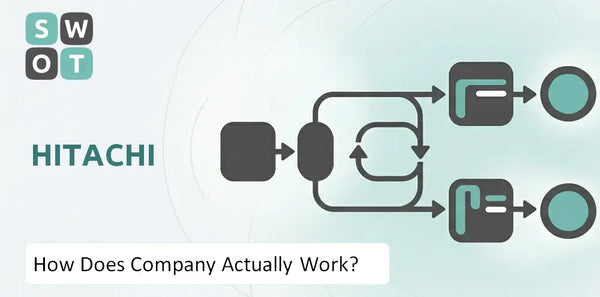
Hitachi company runs day to day on a True One Hitachi operating model: operational technology (OT) assets produce data, Lumada processes that data (IT), and insights loop back to improve assets; GlobalLogic accelerates digital engineering and Customer Zero pilots solutions internally before client rollout.

Unified, sector – agnostic operating model
True One Hitachi breaks silos across Digital Systems and Services, Energy, Mobility, and Connective Industries so teams share platforms, KPIs, and roadmaps for cross – sector solutions.
Platform – driven product and service delivery
Lumada (Hitachi's data platform) ingests OT telemetry, applies analytics and AI, and exposes APIs and SaaS offerings so customers access insights via cloud subscriptions, professional services, and on – prem deployments.
Customer Zero and digital engineering for development
Hitachi pilots solutions in its own factories (Customer Zero) and uses GlobalLogic's software engineering to build bespoke integrations that connect industrial hardware to cloud environments and scale to client fleets.
Multichannel sales and systems delivery
Sales use direct enterprise contracts, systems integrators, and partner channels; delivery mixes hardware supply, SaaS licensing, and managed services backed by regional delivery centers and global account teams.
Key assets: Lumada, OT fleet, GlobalLogic
Core assets include Lumada, extensive OT installations (factories, grids, rail systems), GlobalLogic engineering teams, and partnerships with cloud providers and industrial OEMs to enable end – to – end solutions.
Practical driver: feedback loop from OT to IT
The OT→IT→OT loop, validated by Customer Zero, compresses deployment cycles, reduces integration defects, and raises ROI so solutions scale reliably across verticals and geographies.

How Hitachi runs operations day to day
Daily operations center on operating industrial assets, collecting telemetry, refining Lumada models, and deploying software updates built by GlobalLogic; Customer Zero means many releases are proven in Hitachi facilities before client rollout.
- True One Hitachi aligns four sectors around shared data, platforms, and KPIs
- Products delivered as combined hardware, SaaS, and professional services via cloud and on – prem integration
- GlobalLogic, cloud partners, and industrial OEMs form the core operational ecosystem
- The OT→IT→OT data loop and Customer Zero pilots drive speed, quality, and commercial scalability
For context on clients and verticals served, see Who Hitachi Company Serves. In fiscal 2025 Hitachi reported consolidated revenues of ¥9.2 trillion and increased digital solutions revenue year – on – year to ¥1.1 trillion, reflecting the shift toward software and services that underpin daily operations.
Hitachi PESTLE Analysis
- Covers All 6 PESTLE Categories
- No Research Needed – Save Hours of Work
- Built by Experts, Trusted by Consultants
- Instant Download, Ready to Use
- 100% Editable, Fully Customizable

How Does Money Come In at Hitachi?
Revenue mixes heavy CAPEX projects and growing high-margin digital streams: large hardware orders in energy and recurring Lumada software/services. Monetization blends one-time system sales with subscription-like digital revenue and long-term service contracts.
Energy hardware and industrial systems drive headline sales
Hitachi company pulls massive one-time revenue from Energy and industrial CAPEX projects; Hitachi Energy had a record order backlog of 43 billion USD at end of fiscal 2024, underpinning short-term cash and backlog visibility.
Lumada digital services as the growth engine
Lumada reached 3,021 billion yen in fiscal 2024, up 29 percent, and by Q3 fiscal 2025 represented 41 percent of consolidated revenue, shifting Hitachi toward recurring, subscription-like income.
Pricing and monetization mix
Hitachi monetizes via one-time equipment sales, multi-year service and maintenance contracts, software licenses, and subscription/usage fees for Lumada platforms, plus project financing on large CAPEX deals.
Primary revenue drivers and mix shifts
Total revenues were 9,783.3 billion yen in fiscal 2024 with a projected 10.3 trillion yen for fiscal 2025; management targets LUMADA 80-20 (80 percent revenue, 20 percent margin) by 2027, so digital mix and recurring contracts now drive valuation and margin expansion.
How money comes in for Hitachi
Hitachi converts demand into revenue through large CAPEX deliveries in energy and industrial systems plus accelerating Lumada digital subscriptions and services, moving the business toward steadier, higher-margin recurring income; see the History of Hitachi Company Explained for context: History of Hitachi Company Explained
- Large CAPEX sales: Hitachi Energy backlog 43 billion USD (FY2024)
- Lumada recurring revenue: 3,021 billion yen in FY2024, +29%
- Monetization: one-time sales, multi-year service contracts, software subscriptions
- Biggest driver: shift in mix to digital/Lumada; Lumada = 41 percent of revenue by Q3 FY2025
Hitachi SOAR Analysis
- Complete SOAR Analysis
- Effortlessly Communicate Your Business Strategy
- Investor-Ready Format
- 100% Editable and Customizable
- Clear and Structured Layout

What Makes Hitachi's Model Strong or Fragile?
Hitachi company's model is strong because it bundles deep industrial engineering with software to capture multi-year demand in energy grids and rail; it is fragile because geopolitical tariffs, China real-estate weakness, and the need to reskill 280,000 employees create execution and market risks.
Platform moat from combined OT and IT
Hitachi business model benefits from rare domain expertise across power grids, trains, and industrial systems plus software (operational technology + information technology) that digitizes hardware into recurring services. This creates a high barrier to entry versus niche software or pure-equipment competitors.
Scale in energy and infrastructure demand tailwinds
Global energy transition and AI data center power needs support multi-year revenue growth in Hitachi operations; 2025 sector capex trends point to elevated spending on grids and transmission, favoring firms with integrated hardware-software offerings.
Key assets and capabilities
Hitachi products and services rest on legacy engineering, installed equipment fleets, long-term service contracts, and a global R&D footprint; its ability to convert installed base into recurring digital revenue is a primary commercial strength.
Partnerships, brands, and execution muscle
Strong OEM relationships, government infrastructure contracts, and brand credibility in rail and energy reduce sales friction; Hitachi corporate structure supports cross-segment solutions sales and large-scale deployments.
Dependencies and constraints
The model depends on steady infrastructure capex, stable geopolitics, and successful workforce reskilling; U.S. reciprocal tariffs and China real-estate stress have already depressed the Connective Industries segment and could further limit global tenders.
Operational and talent limits
Scaling digital services requires converting a manufacturing-first workforce into software-centric teams; failure to reskill significant portions of the 280,000-head global staff would slow margin expansion and recurring revenue growth.
Why the model works and where it can break
Hitachi works when physical infrastructure, software, and long-term service contracts combine to create recurring, high-margin revenue; it breaks when trade barriers, China demand shocks, or failure to reskill the workforce interrupt deployments or delay digital conversion.
- Massive moat from combined OT+IT capabilities and installed fleets
- Installed base, long-term service contracts, and integrated grid solutions
- Exposure to U.S. reciprocal tariffs and China real-estate volatility
- Model appears resilient in 2025-2026 due to energy transition tailwinds, but execution risk is material
For practical context on sales channels and go-to-market, see How Hitachi Company Sells
Hitachi VRIO Analysis
- Covers VRIO Analysis in Details
- Structured for Consultants, Students, and Founders
- 100% Editable in Microsoft Word & Excel
- Instant Digital Download – Use Immediately
- Compatible with Mac & PC – Fully Unlocked

Related Blogs
Frequently Asked Questions
Hitachi sells integrated outcomes built from software and physical infrastructure. Its core offerings include Lumada, HVDC systems, railway signaling, industrial OT services, and other solutions that help customers improve uptime, efficiency, and decarbonization across critical operations.
Disclaimer
All information, articles, and product details provided on this website are for general informational and educational purposes only. We do not claim any ownership over, nor do we intend to infringe upon, any trademarks, copyrights, logos, brand names, or other intellectual property mentioned or depicted on this site. Such intellectual property remains the property of its respective owners, and any references here are made solely for identification or informational purposes, without implying any affiliation, endorsement, or partnership.
We make no representations or warranties, express or implied, regarding the accuracy, completeness, or suitability of any content or products presented. Nothing on this website should be construed as legal, tax, investment, financial, medical, or other professional advice. In addition, no part of this site - including articles or product references - constitutes a solicitation, recommendation, endorsement, advertisement, or offer to buy or sell any securities, franchises, or other financial instruments, particularly in jurisdictions where such activity would be unlawful.
All content is of a general nature and may not address the specific circumstances of any individual or entity. It is not a substitute for professional advice or services. Any actions you take based on the information provided here are strictly at your own risk. You accept full responsibility for any decisions or outcomes arising from your use of this website and agree to release us from any liability in connection with your use of, or reliance upon, the content or products found herein.