
How does EverQuote connect car shoppers to insurers and monetize that match?
EverQuote matches consumer intent to carriers via digital lead marketplaces and data models. In 2025 EverQuote reported higher buyer-seller match rates and 12% year-over-year growth in quoted leads, signaling scalable ad-to-revenue conversion. EverQuote SWOT Analysis
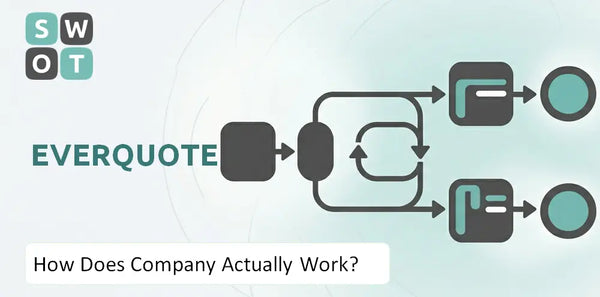
EverQuote sells qualified consumer leads to insurers and charges per lead or via subscription; margins hinge on ad cost and carrier conversion rates. In 2025 average revenue per lead rose, supporting durable unit economics.
What Does EverQuote Actually Sell?
EverQuote sells qualified, high-intent consumer referrals-primarily auto insurance leads-plus home, renters, and life insurance referrals; partners get pre-validated prospects and lower customer acquisition costs (CAC) through a lead generation and insurance comparison platform.
 Core Products: Qualified Insurance Leads
EverQuote sells individual consumer leads: users who searched for insurance, submitted personal and coverage data, and requested quotes. The primary unit is a qualified lead for auto insurance; additional verticals include home, renters, and life insurance leads. Pricing is per-lead or via subscription bundles to insurers and independent agents.
Who It Serves: Carriers and Agents
EverQuote serves national and regional insurance carriers, independent agents, and digital brokers seeking pre-qualified shoppers. It also targets partners with specific underwriting filters-age, vehicle, ZIP, driving record-so referrals match policy eligibility and pricing tiers.
Value Delivered: Lower CAC and Higher Match Rates
Partners receive leads that reduce customer acquisition cost by avoiding broad-market advertising; EverQuote's data shows leads convert at materially higher rates because consumers self-identify intent and coverage needs. In 2025 the platform reported average lead conversion uplift versus generic channels and a measurable decline in time-to-bind for carriers using matched referrals.
Why Partners Choose EverQuote
Customers choose EverQuote for targeted lead quality, underwriting filters, and scalable distribution to agents and carriers. The insurance leads marketplace and comparison platform integrates real-time data, pricing intent signals, and partner-specific routing rules, making it easier and faster to quote and bind policies.
EverQuote's process for getting auto insurance quotes: consumers complete a detailed form; EverQuote scores and validates intent; leads are routed to partners that match underwriting rules; advertisers pay per-lead or per-bundle-this model is the core of how EverQuote makes money. See further context in What EverQuote Company Stands For.
EverQuote SWOT Analysis
- Complete SWOT Breakdown
- Fully Customizable
- Editable in Excel & Word
- Professional Formatting
- Investor-Ready Format

How Does EverQuote Run Day to Day?
EverQuote runs day-to-day as a digital performance marketing engine that converts consumer traffic into verified insurance leads by matching users to carriers via real-time bidding and AI-driven matching. Operations focus on traffic acquisition, instant matching, and monetizing leads through agent and carrier purchases.

Operating model: performance marketing and real-time matching
EverQuote operates a pay-per-lead marketplace: it buys traffic, profiles shoppers, and sells intent-qualified leads to insurers and agents. Sub-second matching pairs consumers with carriers via carrier bidding and profile fit.
Product delivery: lead and call transfer delivery
Consumers access EverQuote via search, social, SEO, and partners, fill a short quote flow, and receive matched insurer options; leads and verified call transfers are delivered to buyers in real time.
Development & data: proprietary algorithms and AI
Engineering maintains matching engines and Smart Campaigns 3.0 (AI) that score intent, predict conversion, and route leads. Data science refines models using conversion outcomes and carrier feedback.
Sales channels: digital acquisition and B2B2C partnerships
Main channels are paid search, social ads, organic SEO, and B2B2C distribution. On the supply side, over 8,000 active independent agents buy leads on EverQuote Pro alongside national carriers via bidding.
Key assets & partnerships: data, carrier network, and agent platform
Critical assets are first-party consumer intent data, carrier bidding relationships, the EverQuote Pro agent marketplace, and real-time call verification systems that support quality control and pricing.
What makes it work: speed, matching accuracy, and monetization
The model depends on sub-second matching latency so leads land while consumers are active, AI-driven match accuracy to raise conversion rates, and dynamic pricing where carriers bid on leads, driving revenue per lead.

Daily operations: traffic to monetized leads in real time
EverQuote converts digital shoppers into sellable insurance leads each day by acquiring traffic, scoring intent with Smart Campaigns 3.0, executing sub-second matches to bidding carriers, and delivering leads or verified call transfers to buyers such as independent agents on EverQuote Pro.
- Core model: performance marketing funnel that monetizes intent via an insurance leads marketplace
- Delivery: instant matched leads and verified call transfers to insurers and over 8,000 active agents
- Main support: proprietary matching algorithms, carrier bidding network, and data pipelines
- Efficiency driver: sub-second matching latency, AI scoring, and dynamic bid pricing that optimize conversion and revenue
For context on strategic direction and 2025 operational priorities, see Where EverQuote Company Is Going
EverQuote PESTLE Analysis
- Covers All 6 PESTLE Categories
- No Research Needed – Save Hours of Work
- Built by Experts, Trusted by Consultants
- Instant Download, Ready to Use
- 100% Editable, Fully Customizable

How Does Money Come In at EverQuote?
EverQuote drives revenue by selling insurance leads and earning referral commissions when consumers engage with carrier offers; pay-per-lead fees and higher-priced verified live transfers form the core monetization. In 2025 total revenue reached 692.5 million dollars, led by auto insurance at 629.8 million dollars and home/renters at 62.7 million dollars.
Auto Insurance Lead Sales: Primary Revenue Engine
EverQuote insurance earns most from selling auto insurance leads to carriers and agents via an insurance leads marketplace; this matters because auto comprised ~91% of 2025 revenue, making it the platform's single biggest cash generator.
Home, Renters, and Diversification Efforts
Secondary revenue comes from home and renters leads and incremental referral commissions; EverQuote reported 62.7 million dollars from these verticals in 2025 and is pushing to hit a non-auto mix target of 25% by end of 2026.
Pricing and Pay-Per-Lead Monetization
Most pricing is pay-per-lead (PPL) or pay-per-conversion, with fees varying by lead quality, exclusivity, and vertical; verified live call transfers command materially higher payouts than static web leads.
What Moves the Revenue Needle
Volume and lead mix drive revenue most: higher-quality, exclusive leads and live transfers increase average price per lead, while consumer traffic scale sustains unit sales to carriers and agents.
How Money Comes In at EverQuote
EverQuote converts consumer demand into revenue by matching shoppers with insurers and charging carriers per engaged lead or conversion; in 2025 this generated 692.5 million dollars, with auto the dominant vertical.
- Primary: pay-per-lead sales for auto insurance, 629.8 million dollars in 2025
- Secondary: home and renters leads and referral commissions, 62.7 million dollars in 2025
- Model: variable PPL and pay-per-conversion pricing-live call transfers pay highest rates
- Driver: lead quality, exclusivity, and volume-mix shifts can materially change revenue
See additional corporate context in the article Who Owns EverQuote Company for ownership and structural details relevant to the business model.
EverQuote SOAR Analysis
- Complete SOAR Analysis
- Effortlessly Communicate Your Business Strategy
- Investor-Ready Format
- 100% Editable and Customizable
- Clear and Structured Layout

What Makes EverQuote's Model Strong or Fragile?
EverQuote's model is strong due to scale, a deep data moat, and a pristine 2025 balance sheet, but fragile because it depends heavily on digital traffic costs and insurance carrier marketing budgets that swing with underwriting cycles.
Scale and Financial Optionality
EverQuote is a top-three digital referral platform in the US with over 2 billion consumer touchpoints powering match optimization. It closed fiscal 2025 with $171 million in cash and $0 debt, enabling M&A or share repurchases.
Proprietary Data and High Margins
EverQuote's data moat improves conversion and pricing for advertisers, supporting an efficient model and a reported 2025 gross margin near 97%, which leaves most revenue available to cover fixed costs and invest in growth.
Concentration on Paid Digital Traffic
Traffic acquisition relies heavily on platforms like Google and Meta; rising cost-per-click compresses Variable Marketing Margin (VMM) and directly reduces profitability per lead.
Pro-cyclicality from Carrier Budgets
Insurance carrier spend is cyclically tied to underwriting performance-when carriers report high loss ratios they cut acquisition budgets, which in 2022-2023 materially reduced demand for leads and hurt revenue.
Net: Why the Model Can Win or Break
EverQuote's combination of scale, near-100% gross margins, and $171 million of cash make the business powerful; however, dependence on paid digital traffic and carrier marketing cycles makes revenue and VMM volatile. Growth in 2025-2026 looks promising as carriers redeploy budgets, but the model remains pro-cyclical and traffic-cost sensitive.
- Top structural strength: massive data moat from over 2 billion consumer touchpoints
- Key capability: highly efficient operations with a 2025 gross margin ≈ 97%
- Principal dependency: paid search/social traffic costs and Google/Meta pricing
- Resilience view: exposed but potentially durable if carriers sustain digital budgets and traffic costs stabilize
Near-term Outlook and Targets
Management targets $1 billion in revenue within two to three years; Q1 2026 revenue guidance is between $175 million and $185 million, reflecting a shift from rate restoration to profitable policy growth among carriers and reopening digital acquisition budgets.
Where to Read More About Who They Serve
For context on EverQuote customers and advertiser segments, see Who EverQuote Company Serves.
EverQuote VRIO Analysis
- Covers VRIO Analysis in Details
- Structured for Consultants, Students, and Founders
- 100% Editable in Microsoft Word & Excel
- Instant Digital Download – Use Immediately
- Compatible with Mac & PC – Fully Unlocked

Related Blogs
- What Does EverQuote Company Stand For?
- How Did EverQuote Company Become What It Is Today?
- Who Owns EverQuote Company and Why Does It Matter?
- How Does EverQuote Company Sell Its Products and Services?
- Where Is EverQuote Company Going Next?
- Who Does EverQuote Company Serve?
- Who Does EverQuote Company Compete With?
Frequently Asked Questions
EverQuote sells qualified insurance leads and referrals, primarily for auto insurance, with additional home, renters, and life insurance leads. The company connects consumers who have submitted quote information with carriers and independent agents that want pre-validated, high-intent prospects and lower customer acquisition costs.
Disclaimer
All information, articles, and product details provided on this website are for general informational and educational purposes only. We do not claim any ownership over, nor do we intend to infringe upon, any trademarks, copyrights, logos, brand names, or other intellectual property mentioned or depicted on this site. Such intellectual property remains the property of its respective owners, and any references here are made solely for identification or informational purposes, without implying any affiliation, endorsement, or partnership.
We make no representations or warranties, express or implied, regarding the accuracy, completeness, or suitability of any content or products presented. Nothing on this website should be construed as legal, tax, investment, financial, medical, or other professional advice. In addition, no part of this site - including articles or product references - constitutes a solicitation, recommendation, endorsement, advertisement, or offer to buy or sell any securities, franchises, or other financial instruments, particularly in jurisdictions where such activity would be unlawful.
All content is of a general nature and may not address the specific circumstances of any individual or entity. It is not a substitute for professional advice or services. Any actions you take based on the information provided here are strictly at your own risk. You accept full responsibility for any decisions or outcomes arising from your use of this website and agree to release us from any liability in connection with your use of, or reliance upon, the content or products found herein.