
How does Everest Group, Ltd. combine primary insurance and reinsurance to underwrite complex corporate risks?
Everest Group, Ltd. runs dual businesses: a primary insurer for corporate risks and a reinsurer for insurers, letting it deploy capital across the risk cycle. In 2025 it reported expanding reinsurance capacity and float-driven investment income, signaling durable premium and capital scale.
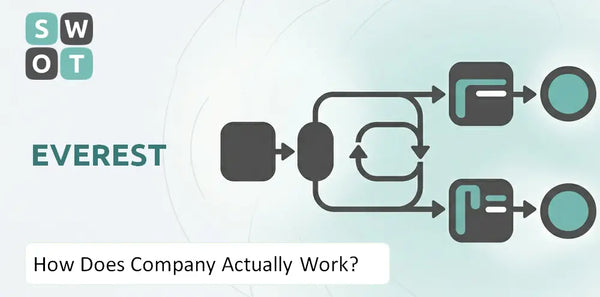
Everest prices bespoke policies, cedes and assumes risk, and earns via underwriting margins plus investment yield; watch loss ratios and invested assets for durability. See Everest SWOT Analysis.
What Does Everest Actually Sell?
Everest Group, Ltd. sells financial certainty via insurance and reinsurance policies that transfer catastrophic and unpredictable loss risk onto its balance sheet, covering cyber, renewable energy, aviation, and large commercial exposures.
 Core Insurance and Reinsurance Products
Everest company services explained: primary offerings are specialty insurance lines for complex, high-value risks and treaty facultative reinsurance capacity sold to other insurers to protect solvency. In 2025 Everest Group, Ltd. reported written premiums and reinsurance cessions totalling approximately $7.2 billion (gross written premium equivalent), reflecting scale across Property, Casualty, Professional lines and Specialty products.
Who It Serves
Clients include mid-to-large corporations facing cyber and renewable project risks, aviation operators, and other insurers seeking reinsurance capacity. See detailed market segments in this industry note: Who Everest Company Serves.
Value Delivered
Customers gain loss-transfer, capital relief, and balance-sheet protection so they can pursue higher-risk projects or stabilize earnings; Everest's 2025 combined ratio for specialty lines was near 92%, indicating underwriting profitability and value for buyers seeking reliable coverage.
Why Customers Choose Everest
Buyers pick Everest for tailored coverage, deep actuarial capacity, and global distribution that supports large placements and complex risk structuring. Its reinsurance pricing and capacity help insurers manage peak exposures and regulatory capital needs, with claims teams experienced in complex event response and settlement.
Everest SWOT Analysis
- Complete SWOT Breakdown
- Fully Customizable
- Editable in Excel & Word
- Professional Formatting
- Investor-Ready Format

How Does Everest Run Day to Day?
Day-to-day, Everest Group, Ltd. balances actuarial underwriting with active capital management: underwriters price and renew risks while an investment team manages the premium float to fund claims and generate returns.

Operating model: disciplined underwriting meets portfolio management
Underwriters apply a one renewal standard to accept only accounts that meet profitability targets; in 2025 Everest Group, Ltd. intentionally shrank its insurance book to focus on Global Wholesale and Specialty lines.
Product delivery: policy issuance to brokers and clients
Policies are issued through wholesale brokers and specialty distribution partners; claims and policy administration run via centralized operations so clients access coverage and support through broker portals and direct servicing teams.
Development: risk selection and portfolio reshaping
Actuarial models, loss-cost studies, and renewal discipline guide product tweaks; the firm reduced volume in commodity lines in 2025 to reallocate capital toward higher-margin specialty business.
Sales: wholesale distribution and specialty brokers
Main channels are global wholesale brokers and specialty intermediaries; placement follows negotiated terms, with underwriting appetite communicated via broker platforms and account managers.
Key assets: investment portfolio and underwriting tools
Everest Group, Ltd. held an investment portfolio of 45.4 billion USD as of December 31, 2025; about 87 percent of holdings are high-quality fixed income and cash, supporting liquidity for claims and surplus stability.
Why it works: float monetization and strict renewal discipline
Collecting premiums upfront lets the investment team earn carry on float while underwriters limit loss exposure with a walk-away renewal policy; that pairing stabilizes earnings and capital allocation.

Daily mechanics: underwriting standards plus active float management
Everest Group, Ltd. runs its business by enforcing a one renewal underwriting standard while investing premium float primarily in short-duration, high-quality fixed income to fund claims and enhance returns.
- Core model: disciplined underwriting with a one renewal standard and targeted portfolio shrinkage into Global Wholesale and Specialty lines
- Service delivery: policies placed via wholesale and specialty brokers, serviced through centralized claims and support teams
- Main support: a 45.4 billion USD investment portfolio (12/31/2025) with ~87 percent in fixed income and cash provides liquidity and yield
- Efficiency driver: upfront premium collection (float) invested for returns while renewal discipline preserves underwriting profitability
For operational history and evolution, see History of Everest Company Explained
Everest PESTLE Analysis
- Covers All 6 PESTLE Categories
- No Research Needed – Save Hours of Work
- Built by Experts, Trusted by Consultants
- Instant Download, Ready to Use
- 100% Editable, Fully Customizable

How Does Money Come In at Everest?
Everest Group, Ltd. earns primarily from underwriting insurance policies and from investing the premiums it collects; underwriting generated USD 17.7 billion in gross written premiums in 2025 while investments produced a record USD 2.1 billion in net investment income.
Underwriting: the core revenue engine
Underwriting income comes from gross written premiums and is measured by loss experience and the combined ratio; Everest reported a 98.6 percent combined ratio in 2025, with Reinsurance at 91.7 percent, making underwriting the primary profit driver.
Investments: steady, recurring cash flow
Net investment income stabilizes earnings between underwriting cycles; in 2025 Everest recorded USD 2.1 billion, aided by a fixed – income book yield near 4.5 percent, which boosted operating and net ROE.
Pricing and monetization model
Products are priced as insurance policies with premiums set by risk assessment, actuarial models, and competitive market rates; revenue recognition follows premium writings less ceded reinsurance and claims paid.
Key drivers of revenue
Volume of gross written premiums, loss ratio control (combined ratio), reinvestment yields, and asset allocation drive top-line and profitability; in 2025 these combined to produce a net income ROE of 10.5 percent and an operating ROE of 12.4 percent.
How Money Comes In
Everest converts customer demand into revenue by writing insurance premiums (underwriting) and investing the float; premiums supply cash and investments generate steady income, together producing the group's 2025 earnings profile.
- Underwriting via gross written premiums: USD 17.7 billion in 2025
- Net investment income from invested float: USD 2.1 billion in 2025
- Monetization: premium pricing, reinsurance ceded, and investment returns
- Primary revenue driver: premium volume and combined ratio (combined ratio 98.6%; Reinsurance 91.7%)
See a practical operational view in this article on how Everest sells: How Everest Company Sells
Everest SOAR Analysis
- Complete SOAR Analysis
- Effortlessly Communicate Your Business Strategy
- Investor-Ready Format
- 100% Editable and Customizable
- Clear and Structured Layout

What Makes Everest's Model Strong or Fragile?
Everest company model is strong from diversification, proactive reinsurance, and a USD 1.2 billion adverse development cover executed in late 2025, yet fragile to climate-amplified catastrophes and social inflation that generated USD 757 million pre-tax catastrophe losses in 2025.
Strategic capital and reinsurance shield
The firm's USD 15.5 billion shareholders equity and the late – 2025 USD 1.2 billion adverse development cover materially reduce reserve volatility and enable selective underwriting in a hard market, strengthening how does Everest company work in practice.
High-margin specialty focus
By exiting lower-margin retail lines and prioritizing specialty underwriting, the Everest company business model increases margin per policy and supports aggressive capital returns like share repurchases in 2026.
Concentration and catastrophe exposure
The model depends on reinsurance and capital markets capacity; large nat – cat events or correlation shocks from climate change could overwhelm protections, as seen in the USD 757 million 2025 hit.
Durability in 2025-2026
As of 2026 the business is leaner and more resilient after portfolio pruning and capital returns, but sustainability hinges on catastrophe frequency, social inflation trends, and continued access to reinsurance capital.
Model strengths versus fragilities
The clearest takeaway: strong capital and targeted reinsurance make the Everest company business model work, while climate – amplified catastrophes and social inflation remain the biggest risks that could weaken it.
- Robust capital base with USD 15.5 billion shareholders equity
- Adverse development cover of USD 1.2 billion ring – fences legacy North American liabilities
- Key dependency on reinsurance markets and catastrophe frequency
- Model appears more resilient in 2026 but exposed to escalating climate risk and social inflation
Further context on ownership and corporate structure is available in this article: Who Owns Everest Company
Everest VRIO Analysis
- Covers VRIO Analysis in Details
- Structured for Consultants, Students, and Founders
- 100% Editable in Microsoft Word & Excel
- Instant Digital Download – Use Immediately
- Compatible with Mac & PC – Fully Unlocked

Related Blogs
Frequently Asked Questions
Everest sells insurance and reinsurance policies that transfer catastrophic and unpredictable loss risk to its balance sheet. The blog says its offerings cover specialty risks like cyber, renewable energy, aviation, and large commercial exposures, along with reinsurance capacity for other insurers.
Disclaimer
All information, articles, and product details provided on this website are for general informational and educational purposes only. We do not claim any ownership over, nor do we intend to infringe upon, any trademarks, copyrights, logos, brand names, or other intellectual property mentioned or depicted on this site. Such intellectual property remains the property of its respective owners, and any references here are made solely for identification or informational purposes, without implying any affiliation, endorsement, or partnership.
We make no representations or warranties, express or implied, regarding the accuracy, completeness, or suitability of any content or products presented. Nothing on this website should be construed as legal, tax, investment, financial, medical, or other professional advice. In addition, no part of this site - including articles or product references - constitutes a solicitation, recommendation, endorsement, advertisement, or offer to buy or sell any securities, franchises, or other financial instruments, particularly in jurisdictions where such activity would be unlawful.
All content is of a general nature and may not address the specific circumstances of any individual or entity. It is not a substitute for professional advice or services. Any actions you take based on the information provided here are strictly at your own risk. You accept full responsibility for any decisions or outcomes arising from your use of this website and agree to release us from any liability in connection with your use of, or reliance upon, the content or products found herein.